
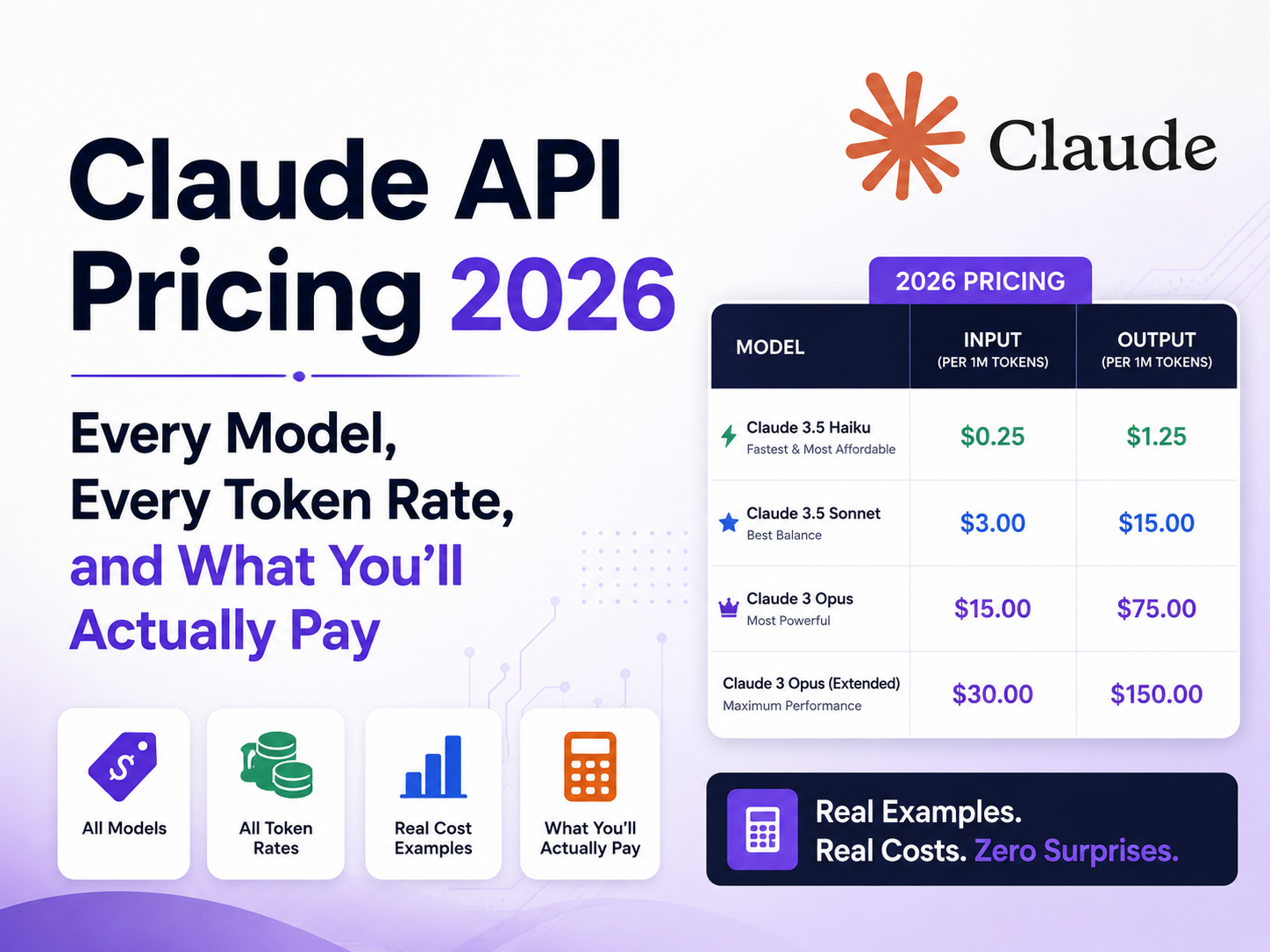
Claude API Pricing 2026 — Every Model, Every Token Rate, and What You’ll Actually Pay
Claude API pricing in 2026 is pay-as-you-go, billed per million tokens — with zero monthly minimum and no subscription required. Every API call has two costs: input tokens (your prompt, system instructions, and context) and output tokens (Claude’s response). Output tokens cost exactly five times input tokens across current models. This guide covers every model rate, what a million tokens actually looks like in practice, and the two discount levers (batch processing and prompt caching) that can cut your bill significantly — cross-checked directly against Anthropic’s own live pricing page rather than secondhand trackers.
🟢 Haiku 4.5: $1.00 input / $5.00 output — cheapest, fastest
🟡 Sonnet 5: $2.00 input / $10.00 output — current default for coding and agents, now a permanent rate
🟣 Opus 5: $5.00 input / $25.00 output — current flagship, best for complex agentic work
🔴 Fable 5.1: $10.00 input / $50.00 output — Anthropic’s most capable generally available model
Still available (previous generation): Sonnet 4.6 ($3/$15), Opus 4.8 ($5/$25), and older legacy models
Batch API: 50% off everything | Prompt caching: up to 90% off repeated input
📋 Table of Contents
- What is Claude API Pricing and How Does It Work?
- Claude API Pricing — All Current Models (September 2026)
- Claude Sonnet API Pricing — Current vs Previous Generation
- Claude Haiku 4.5 — When Cheap Actually Means Smart
- Claude Opus 5 — What the Flagship Actually Costs
- What Does This Actually Cost? Real Usage Examples
- Batch API — The 50% Discount Most Developers Skip
- Prompt Caching — Up to 90% Off Repeated Input
- Other API Costs: Web Search, Code Execution, Managed Agents
- Claude Code API Pricing — Separate From Subscriptions
- API vs Subscription — Which Do You Need?
- How Much Does Claude Cost for a Real Application?
- 5 Ways to Cut Your Claude API Bill
- Frequently Asked Questions
What is Claude API Pricing and How Does It Work?
Understanding Anthropic Claude API pricing 2026 starts with one simple fact: the Claude API is Anthropic’s developer interface — the programmatic way to send messages to Claude and receive responses from an application rather than a chat window. Every API call is billed on what you send and what you get back. Anthropic counts both in tokens — the chunks of text that language models process. A rough rule of thumb: one million tokens is approximately 750,000 words, or about 15 full-length novels.
If that still sounds abstract, here’s a more practical frame: a typical customer service response averages around 300 output tokens. That means Claude Haiku 4.5 can generate roughly 3,300 customer service responses for $5. That’s the order of magnitude we’re talking about.
Crucially, Claude API pricing is completely separate from Claude subscription pricing. If you pay for Claude Pro on claude.ai, that does not include API access. And if you’re a developer building an app on the API, you don’t need a subscription. They are two entirely different products.
Claude API Pricing — All Current Models (September 2026)
As of this update, Anthropic’s current-generation lineup is Haiku 4.5, Sonnet 5, Opus 5, and Fable 5.1. Previous-generation models — including Sonnet 4.6 and Opus 4.8, both of which were the flagship options earlier in 2026 — remain fully available and supported at their original listed rates; Anthropic doesn’t retire a model’s API access just because a newer one has shipped.
| Model | Input (per 1M tokens) | Output (per 1M tokens) | Context Window | Best For |
|---|---|---|---|---|
Haiku 4.5claude-haiku-4-5-20251001Current | $1.00 | $5.00 | 200K | Classification, routing, summarization, high-volume tasks |
Sonnet 5claude-sonnet-5Current | $2.00 | $10.00 | 1M (200K on the free consumer plan) | Coding and agents — Anthropic’s current high-performance default |
Opus 5claude-opus-5Current | $5.00 | $25.00 | 1M | Complex agentic coding, enterprise work — current flagship |
Fable 5.1claude-fable-5-1Current | $10.00 | $50.00 | 1M | Anthropic’s most capable generally available model — sits above the Opus tier |
Sonnet 4.6claude-sonnet-4-6Previous gen | $3.00 | $15.00 | 200K | Still supported; Sonnet 5 now costs less per token and is the current recommendation |
Opus 4.8claude-opus-4-8Previous gen | $5.00 | $25.00 | 200K | Still supported; Opus 5 is the current flagship at the same price |
One important note on tokenizers: Anthropic has confirmed that Sonnet 5 uses a newer tokenizer than Sonnet 4.6, and that it produces roughly 30% more tokens for the same input text. A document that cost fewer tokens under the old tokenizer costs more tokens under the new one, even though the per-token price is lower. If you are migrating between model generations, recount your token estimates on a real sample rather than assuming a simple model-swap calculation transfers directly — the lower sticker price doesn’t automatically mean a lower bill.
Claude Sonnet API Pricing — Current vs Previous Generation
Claude Sonnet 5 is Anthropic’s current high-performance model for coding and agentic work, priced at $2.00 per million input tokens and $10.00 per million output tokens. Claude Sonnet 4.6, the previous flagship in this tier, remains available at $3.00/$15.00 — a genuinely higher price for a model Anthropic itself now positions as the older option, so there’s little reason to default to 4.6 for new projects unless you have a specific compatibility reason.
Sonnet 4.6 does have the advantage of a longer track record — more third-party testing data, more community troubleshooting content, and more accumulated production experience, simply because it’s been out longer. For most new builds, though, Sonnet 5 is both cheaper and Anthropic’s current recommendation for the same class of work.
Claude Sonnet — Example Cost Calculations (Sonnet 5 rates)
Claude Haiku 4.5 — When Cheap Actually Means Smart
Claude Haiku 4.5 costs $1.00 per million input tokens and $5.00 per million output tokens — making it 5x cheaper than Sonnet 5 and 25x cheaper than Opus 5 per token. But Haiku isn’t just a budget fallback. For many production tasks, it’s genuinely the right tool.
Haiku handles classification, entity extraction, summarization, intent detection, content routing, and FAQ responses reliably. These are high-frequency, low-complexity tasks where Opus-level reasoning adds cost without adding meaningful quality. A customer support system routing 100,000 queries per month through Haiku costs roughly $100–$200 depending on average message length. The same volume on Opus 5 would cost $1,000–$2,000+.
Claude Haiku 4.5
Best for VolumeUse for: content classification, simple Q&A, entity extraction, spam detection, intent routing. Fastest model in the lineup. 200K context window.
Claude Sonnet 5
Current DefaultUse for: general generation, coding help, document analysis, customer support, RAG pipelines, agentic tasks. Anthropic’s current recommendation for most production workloads.
Claude Opus 5
Current FlagshipUse for: complex multi-step reasoning, long-horizon coding, research synthesis, high-stakes decisions where quality directly impacts revenue. Fast Mode available at 2x standard pricing for ~2.5x faster responses.
Claude Fable 5.1
Most PowerfulUse for: long-running agents and specialized production tasks requiring maximum capability. Anthropic’s most capable generally available model, sitting above the Opus tier. 10× the cost of Haiku — evaluate carefully whether Opus 5 covers your need at half the price.
What Does This Actually Cost? Real Usage Examples
Abstract pricing tables are fine. Concrete numbers that match real applications are more useful. Here are common AI application scenarios with cost estimates using current Sonnet 5 pricing as the baseline.
| Application | Avg Tokens Per Call | Haiku 4.5 | Sonnet 5 | Opus 5 |
|---|---|---|---|---|
| 1,000 customer service responses | 500 in / 200 out | $0.60 | $1.20 | $3.00 |
| 100 product descriptions (e-commerce) | 2K in / 800 out | $0.60 | $1.20 | $3.00 |
| 500 emails drafted (sales outreach) | 3K in / 1.5K out | $3.75 | $7.50 | $18.75 |
| 50 long-form blog articles | 5K in / 8K out | $2.75 | $4.50 | $13.75 |
| 1,000 document classifications | 2K in / 50 out | $2.25 | $4.50 | $11.25 |
| 100 code review passes | 8K in / 3K out | $5.50 | $11.00 | $27.50 |
The pattern is clear: for high-frequency, low-complexity tasks (customer service routing, classification, short responses), Haiku wins on cost by a large margin. For infrequent, high-value tasks (code review, complex analysis), Opus’s quality advantage typically justifies the price premium. The mistake most teams make is using Opus for tasks Haiku or Sonnet handle perfectly well.
Batch API — The 50% Discount Most Developers Skip
Anthropic’s Batch API is one of the most underused cost levers in Claude’s pricing. It works by submitting a set of requests to be processed asynchronously, rather than in real time. The trade-off: you wait a bit longer. The reward: every token — input and output — at 50% of the standard price, across every model.
Batch API is not appropriate for every workflow. If your application needs a live response — a chatbot answering a user, a real-time API call, anything latency-sensitive — batch doesn’t fit. But for any asynchronous workload, it’s a straightforward switch with immediate savings:
- Overnight data processing: Document classification, entity extraction, content moderation at scale
- Bulk content generation: Product descriptions, SEO drafts, email sequences
- Scheduled analysis: Report summarization, sentiment analysis on yesterday’s data
- Model evaluation: Running test sets against new prompts or models
Prompt Caching — Up to 90% Off Repeated Input
Prompt caching is the second major cost lever — and unlike batch processing, it benefits real-time applications too. The concept: if you send the same large block of text in every API call (a system prompt, a document, a set of rules), you can cache it after the first call and pay a small fraction of the standard input price for cache hits on subsequent calls.
Prompt Caching — What It Saves on a Real Scenario (Sonnet 5)
Per Anthropic’s current published rates, a 5-minute cache write costs 1.25× the model’s standard input price, and cache reads cost roughly 10% of standard input — for Sonnet 5, that’s a $2.50/MTok write and a $0.20/MTok read against a $2.00/MTok base input rate. A longer 1-hour cache option is also available at a higher write cost, better suited to high-frequency applications reusing the same content across a longer window. There’s also a minimum cacheable block size below which content won’t cache at all — this varies by model, so check the size of your actual system prompt against current documentation rather than assuming a short prompt qualifies.
Other API Costs: Web Search, Code Execution, and Managed Agents
Token pricing isn’t the whole picture. A few Claude Platform features are billed separately, on top of standard token costs, per Anthropic’s current pricing page:
- Web search: $10 per 1,000 searches, in addition to the input/output tokens needed to process the search results.
- Code execution: the first 50 hours per day per organization are free; additional hours cost $0.05 per hour per container.
- Managed Agents (public beta): $0.08 per session-hour of active runtime, on top of standard token costs for whatever model the agent uses.
- US-only data residency: workloads that need to run exclusively on US infrastructure carry a 1.1× multiplier on standard input and output token pricing.
None of these are large costs individually, but they’re easy to miss when budgeting a production deployment that leans on tool use — worth checking against your actual expected call volume before finalizing a cost estimate.
Claude Code API Pricing — Separate From the Subscription
Claude Code is Anthropic’s agentic coding tool — it runs in the terminal, reads your codebase, writes and executes code, and handles multi-step engineering tasks autonomously. There are two distinct ways to access it with very different pricing.
Claude Code via Subscription
Claude Code is included in all paid Claude subscription plans — starting with Pro at $17/month billed annually (or $20/month billed monthly), through Max ($100+/month) and Team plans. Claude Code sessions draw from the same usage pool as regular chat, so higher-tier plans simply give you more headroom, not a separate allowance. Occasional interactive use fits comfortably on Pro; developers running long or frequent Claude Code sessions typically need Max or Team to avoid hitting limits.
Claude Code via API
Developers building applications that use Claude Code’s capabilities programmatically pay standard API token rates for the underlying Claude model — commonly Opus 5 for complex tasks ($5/$25 per million tokens), or Sonnet 5 for lighter workloads. There is no separate “Claude Code” API tier. You call Claude with the appropriate tools and system prompt; token consumption and billing are identical to any other API call. For automated pipelines processing large codebases, Batch API at 50% discount applies.
Claude API vs Subscription — Which Do You Actually Need?
| Feature | Claude API (Pay-as-you-go) | Claude Subscription (Pro/Max/Team) |
|---|---|---|
| Who it’s for | Developers building apps | Individuals using Claude.ai chat |
| Billing model | Pay per token — no minimum | Fixed monthly fee |
| Claude.ai chat access | ❌ Not included | ✅ Included |
| API access | ✅ Full access | ❌ Not included |
| Claude Code (interactive) | ❌ Not directly | ✅ All paid plans (Pro, Max, Team) |
| Usage limit | None (pay for what you use) | Rolling 5-hour session limits, plus weekly caps on paid plans |
| Good for low usage? | Yes — no minimum | Yes — predictable monthly cost |
| Good for high volume? | Yes — scales linearly | Limited — hits usage limits, though paid plans can enable pay-as-you-go usage credits at standard API rates once limits are reached |
| Starting price | $0 (pay for tokens only) | $17/month annual, $20/month monthly (Claude Pro) |
The shortest decision rule: if you are building an application, integration, or automated workflow — you need the API. If you are personally using Claude to write, research, or code with Claude Code interactively — you need a subscription. Some teams use both: engineers on Pro or Max subscriptions for daily interactive use, plus API keys for the products they’re building.
How Much Does Claude Actually Cost for a Real Application?
Let’s run the numbers on a realistic production application — a customer-facing AI assistant handling 10,000 queries per month, each averaging 1,500 input tokens and 500 output tokens.
Real App Cost: 10,000 Queries/Month
This is why model selection matters more than most developers initially expect. The same 10,000 monthly queries cost $40 on Haiku, $80 on Sonnet 5, or $200 on Opus 5. With prompt caching, Sonnet drops further into the $35–45 range. Choosing the right model for the task is the most impactful cost optimization available — before you touch batch processing, prompt engineering, or output minimization.
5 Ways to Reduce Your Claude API Costs
- Use the right model for the task. Classify with Haiku. Write and build with Sonnet 5. Reason through the hardest problems with Opus 5. This single habit reduces costs faster than any other optimization. Benchmark your specific task on Haiku first — it handles more than most developers initially assume.
- Enable the Batch API for async workloads. Any processing that doesn’t need a real-time response should go through the Batch API. It’s a 50% discount on every token across every model. The implementation is a single endpoint change and a polling loop.
- Cache your system prompt. If you include a long system prompt (instructions, persona, context) in every API call, prompt caching reduces those repeated input tokens by up to 90%. Even a 2,000-token system prompt with 10,000 daily calls saves meaningful money.
-
Minimize output tokens explicitly. Set
max_tokensto the realistic maximum for your use case — not the model’s maximum. Ask Claude to be concise in your system prompt. Output tokens cost 5× input tokens; every word Claude doesn’t write is money saved. - Monitor spending by model from day one. Set usage alerts in the Anthropic Console before your application reaches production scale. AI API spend can compound quickly — a prompt that generates twice the expected output tokens on 10% of requests can meaningfully inflate your monthly bill. Monitor early, set alerts, catch surprises before they’re expensive.
✅ Bottom Line — Is Claude API Pricing Competitive in 2026?
Yes — particularly at the Haiku and Sonnet tiers. Claude Haiku 4.5 at $1/$5 per million tokens is among the most cost-effective API options for production-scale AI features. Claude Sonnet 5 at $2/$10 delivers Anthropic’s current recommended coding and agentic performance at a price point most product teams can sustain — and as of August 10, 2026, that rate is confirmed permanent, not introductory, making it genuinely cheaper than the previous-generation Sonnet 4.6 it replaced as the default. The batch processing (50% off) and prompt caching (up to 90% off cached input) levers bring costs down further than most developers realize before they start.
The place where Claude API pricing requires careful attention is model selection at scale. The cost difference between Haiku and Opus for the same workload is 25×. Most production applications use a mix — cheap models for routing and classification, smarter models for generation — which brings the blended cost per call into a range that scales predictably.
Always verify current rates at claude.com/pricing before finalizing any production budget. Anthropic updates model availability and pricing without advance notice — the rates in this guide were checked directly against that page as of September 15, 2026, but the landscape moves fast, and this article originally flagged, and has now confirmed, a widely-circulated pricing claim that didn’t match Anthropic’s own source.
Frequently Asked Questions
How much does Claude API cost in 2026?
Claude API pricing is billed per million tokens. As of September 2026, checked directly against Anthropic’s own pricing page: Haiku 4.5 at $1.00 input / $5.00 output, Sonnet 5 at $2.00 / $10.00, Opus 5 at $5.00 / $25.00, and Fable 5.1 at $10.00 / $50.00. Previous-generation models remain available at their listed rates. Batch API cuts all costs by 50%. Prompt caching reduces repeated input costs by up to 90%. Verify current rates at claude.com/pricing.
What is Anthropic Claude API pricing for Sonnet?
Claude Sonnet 5, the current-generation model, costs $2.00 per million input tokens and $10.00 per million output tokens. The previous-generation Sonnet 4.6 remains available at $3.00/$15.00 for anyone who needs it. With batch processing, Sonnet 5 drops to $1.00/$5.00. Prompt caching reduces the system prompt portion by up to 90%. Sonnet 5’s $2/$10 rate launched as introductory pricing through August 31, 2026; on August 10, 2026, Anthropic confirmed it directly, making the rate permanent and cancelling the scheduled increase to $3/$15.
How much does Claude cost for everyday use?
For individual everyday use — writing, coding help, research — the Claude.ai Pro subscription (from $17/month billed annually) is the appropriate product, not the API. For developers running applications, the API costs roughly $0.01–$0.10 per typical user interaction depending on message length and model choice. A 10,000-query-per-month application on Haiku costs approximately $40; on Sonnet 5, approximately $80. There is no monthly minimum on the API — you pay only for what you use.
What is Claude Code API pricing?
Claude Code does not have a separate API pricing tier. Programmatic access to Claude Code capabilities uses standard API token rates for the underlying model. Claude Code as an interactive tool is included in all paid Claude subscription plans, starting with Pro from $17/month; Max and Team plans add higher usage limits. The API and subscription are distinct billing systems and neither includes the other.
Does Claude API have a free tier?
Anthropic does not offer a permanent free API tier for production use. New accounts typically start on prepaid credits for testing the API before committing budget. This is separate from the free claude.ai chat product, which is a consumer offering. API usage requires a funded account balance. There is no monthly minimum — you can spend $0 in a given month simply by making no API calls.
How does Anthropic Claude API pricing work for tokens?
The Claude API bills input and output tokens separately per million tokens consumed. Input tokens are everything you send: your prompt, system instructions, conversation history, and any documents or context. Output tokens are everything Claude generates in response. Output costs exactly 5× input across current Claude models. A 1,000-word prompt is approximately 1,300 input tokens; a 500-word response is approximately 650 output tokens. Actual token counts vary by content.
🚀 Ready to Start Building with Claude API?
Get started:
console.anthropic.com
— create an API key and test with a small prepaid balance
Official pricing page:
claude.com/pricing
— always verify current rates here
Build an AI agency:
Start an AI automation agency in 2026 →
Bookmark CrixPix.com for weekly verified AI tool pricing and developer guides.