How to make money with ai in 2026

How to Make Money with AI in 2026: 10 Real Methods That Work

By Shivam  |  Last Updated: June 2026  |  ⏱ 12 min read

The AI economy is no longer a future forecast — it’s the reality of right now. According to McKinsey Global Institute’s research on generative AI’s economic potential, AI tools are expected to add $2.6 to $4.4 trillion in annual value across global industries (McKinsey Global Institute — The Economic Potential of Generative AI). The window to ride this wave as an individual earner in 2026 has never been wider.

But here’s the honest problem with almost every “make money with AI” article you’ll find today: they hand you a vague list with zero tool recommendations, zero platform guidance, and zero realistic income figures. You get “do content writing” — with no clarity on which tool to use, which platform pays, or what you should even charge on day one. I’ve read dozens of these articles. They’re all the same list, dressed up differently.

This guide fixes every single one of those gaps. Below are 10 real, actionable methods to make money with AI in 2026 — each tied to specific tools, realistic monthly earnings, and a clear first step you can take today. Whether you’re starting from zero or you’re already freelancing, there’s a method here built for your exact situation.
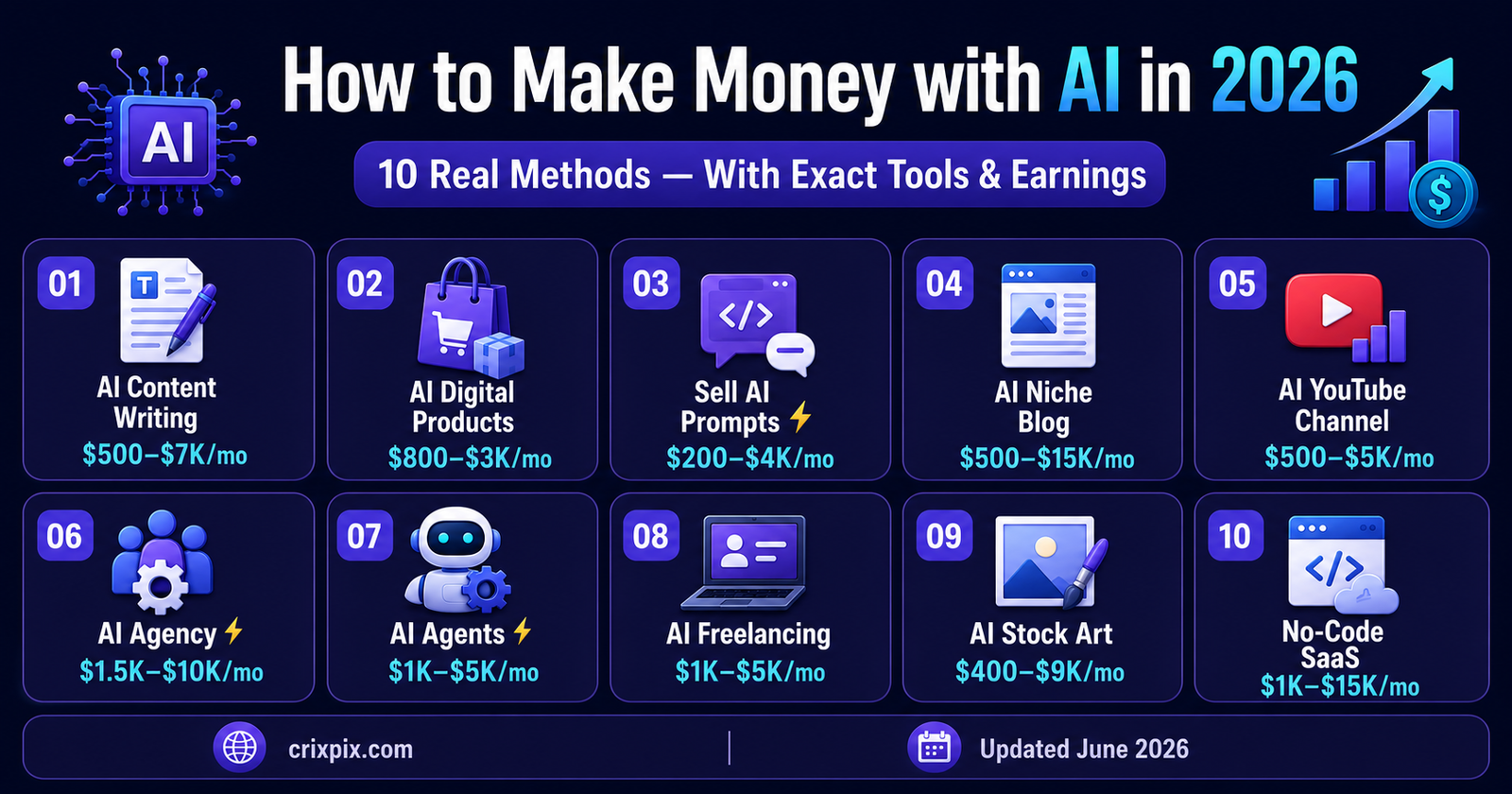
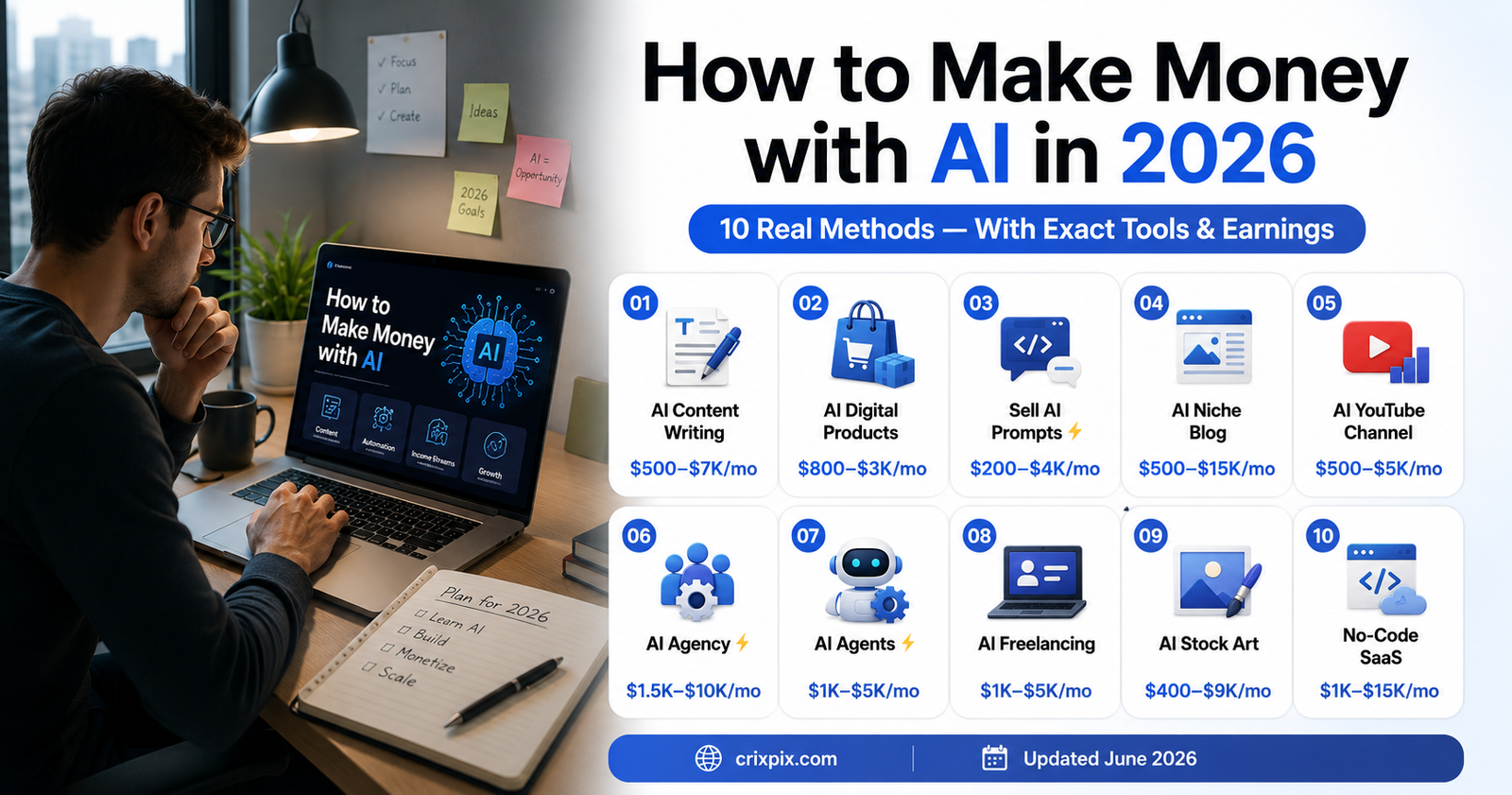
how to make money with ai in 2026 infographic
10 ways to make money with AI in 2026 — crixpix.com

⚡ Key Takeaways

  • AI side hustles are real — but only when a specific tool is matched to a specific method.
  • Beginners with zero experience can start earning within 2–4 weeks using prompt selling or AI content freelancing.
  • The biggest 2026 opportunity most competitors completely miss: AI agents and automation agencies.
  • Every method below links to exact tool reviews already published on CrixPix.
  • Earnings are realistic, not hype. Plan for 10–15 hours/week minimum in the first 90 days.
  • 7 widely believed AI income myths can actively waste your time — we debunk every one below.
  • Most articles skip the tax reality, the failure modes, and how to scale past $5K/month — we cover all three in depth.

🔍 What other guides miss: Most ranking articles on this topic list generic ideas without tool names, earning benchmarks, or a starting point. They also completely ignore the two biggest 2026 trends — AI agents and AI automation agencies. We cover both in depth below.

Method 1: AI Content Writing & Freelancing

Businesses need blog posts, email sequences, product descriptions, and social copy — and they need it constantly. If you know how to use an AI writing tool well, you can produce that content at 5–10× the speed of a traditional writer, undercut agency rates, and still pocket a healthy margin. I’ve seen complete beginners land their first client within a week using nothing but Jasper and a decent Upwork profile. It’s one of the fastest on-ramps into the AI income world.

How It Works

You take a client brief, generate a structured draft using an AI writing tool, edit it for accuracy and tone, and deliver polished content. The AI handles the blank-page problem; your human judgment handles quality. Clients pay for the result — not the process.

Tools You Need

Realistic Earning Potential

Beginners: $500–$1,500/month part-time (5–10 hrs/week). Experienced writers using AI as a multiplier: $3,000–$7,000/month. Rates typically range from $0.05 to $0.25 per word depending on niche and client quality.

💡 Pro Tip

Never sell “AI writing.” Sell outcomes — traffic growth, conversion improvement, email open rates. I always tell new writers: clients don’t care which tool you used; they care whether the article brought them leads. Position yourself as a content strategist who uses AI, and you’ll charge 3× more than the person who says “I use ChatGPT.”

Method 2: Sell AI-Generated Digital Products

Use AI to create ebooks, planners, Notion templates, social media bundles, or Canva kits — then sell them passively on Etsy, Gumroad, or Payhip. The production cost is basically zero. And unlike freelancing, you’re not trading hours for dollars — one good product can sell 500 times while you sleep.

How It Works

Research a problem your target audience has (e.g., “budget planner for freelancers”), use ChatGPT or Claude to draft the content, design it in Canva AI, and list it as a downloadable product. Once it’s uploaded, every sale happens without you lifting a finger — that’s the part that keeps people coming back to this model.

Tools You Need

  • ChatGPT (GPT-5) / Claude (Opus 4.8) — Outline and draft ebook or planner content
  • Canva AI — Design covers, planners, and social template bundles
  • Midjourney V8.1 — Create illustrated covers and product mockups
  • Platforms: Etsy, Gumroad, Payhip, or your own Shopify store

Realistic Earning Potential

A well-optimized Etsy shop with 3–5 digital products earns $800–$3,000/month passively after a 30–60 day setup and SEO period. Top sellers in competitive niches (wedding planning, fitness, budgeting) report $5,000–$12,000/month.

💡 Pro Tip

Research before you create — always. Use the free Erank.com keyword tool to validate demand on Etsy before making a single page. I’d look for a product with 1,000+ monthly searches and fewer than 3,000 competing listings. That gap is where the money is. Skipping this step is why most Etsy sellers make $12/month instead of $1,200.

Method 3: Sell AI Prompts on Marketplaces ⚡

⚠️ Competitor Gap: Almost no editorial article on this topic covers prompt selling with a step-by-step path. This is your fast-win, low-competition entry into the AI income space — and it’s one of the quickest ways to sell ai prompts for money with zero upfront cost.

How It Works

Here’s something most people don’t realise: businesses, creators, and marketers will pay real money for pre-built, tested prompts that save them hours of trial and error. You write the prompt once — it sells repeatedly. Think of it like a template business, except your product costs nothing to duplicate and nothing to ship. This is one of the best ways to make money with ai no experience because your asset is knowledge, not a portfolio.

What Sells Best in 2026

  • Marketing copy prompts (email sequences, ad frameworks, product descriptions)
  • Midjourney V8.1 art-style prompts (portraits, product shots, brand imagery)
  • SEO blog post structure prompts
  • Business plan and pitch deck generation prompts
  • Resume, LinkedIn bio, and cover letter prompts

Tools You Need

  • ChatGPT (GPT-5) / Claude (Opus 4.8) — Test and refine your prompts before listing
  • PromptBase — Largest dedicated prompt marketplace
  • Etsy — Growing secondary market for AI prompt bundles (PDFs)
  • Gumroad — Sell directly with lower fees and full audience control

Realistic Earning Potential

Beginners with 10–20 listings: $200–$600/month. Established sellers with 50+ well-optimized prompts: $1,500–$4,000/month. A single viral Midjourney prompt on PromptBase can earn $300–$800 passively from one listing alone.

Method 4: Launch an AI Niche Blog or Newsletter in 2026

This is exactly the model CrixPix.com runs on. Build a focused content site around AI tools, reviews, and tutorials — then monetize through affiliate commissions, display ads, and sponsored posts. The best part? AI slashes production time so dramatically that a 2,000-word review that once took a full working day now takes under 90 minutes with the right workflow. That’s the power that makes this model so powerful for a solo creator.

How It Works

Pick a micro-niche within AI (e.g., “AI tools for e-commerce sellers” or “AI tools for real estate agents”), build a WordPress site, publish in-depth tool reviews and comparison guides, and earn affiliate commissions every time a reader clicks through and subscribes. The narrower your niche, the faster you rank.

Tools You Need

  • Jasper AI / Writesonic — Draft content outlines and first passes
  • Rank Math SEO — On-page optimization (the same plugin CrixPix uses)
  • WordPress + Kadence or Astra — Fast, SEO-friendly foundation
  • Beehiiv or ConvertKit — If adding a newsletter layer for direct monetization

Realistic Earning Potential

Month 1–3: $0–$300 (building traffic). Month 6–12: $500–$3,000/month from affiliate commissions. Year 2+: $5,000–$15,000/month for a well-positioned niche blog. AI tool affiliate programs pay recurring commissions of 20–45% (Jasper AI pays 25–30% recurring for 12 months per referred subscriber).

💡 Pro Tip

Don’t launch a generic “best AI tools” blog in 2026 — that space is completely saturated. Instead, serve one specific audience: “best AI tools for Shopify store owners,” “AI tools for accountants,” “AI for Amazon FBA sellers.” In my experience, a specific audience converts at 3–5× the rate of a general one, and Google rewards that specificity with faster rankings too.

Method 5: Create AI-Powered Video Content

Faceless YouTube channels powered entirely by AI voiceover, AI-generated visuals, and AI scripts are one of the fastest-growing content formats in 2026. You script with ChatGPT, generate B-roll with Runway ML, add a voice with ElevenLabs, and edit with CapCut AI — no camera, no studio, no face required.

How It Works

Choose a high-CPM YouTube niche (personal finance, AI tutorials, productivity, health). Script a 7–12 minute video with ChatGPT. Generate visuals and voiceover with AI tools. Edit and upload. Repeat 3–4 times per week for 90 days. Consistency beats production quality every single time — especially in the first 90 days.

Tools You Need

  • ElevenLabs — Realistic AI voiceover (Starter: $5/mo | Creator: $22/mo)
  • Synthesia / HeyGen — AI avatar presenter videos for tutorial formats
  • Runway ML Gen-4 / Gen-4.5 — AI-generated B-roll footage from text and image prompts
  • CapCut AI — Automated captions, cuts, and transitions

Realistic Earning Potential

YouTube AdSense RPM for AI/finance niches (US Tier-1 audience): $15–$40 per 1,000 views (verified from creator dashboards, 2026). A channel with 50K subscribers in a high-CPM niche earns $1,500–$5,000/month from ads alone, before sponsorships. Top faceless AI channels in the finance niche report $8,000–$20,000/month at 200K+ subscribers.

💡 Pro Tip

The three highest-paying YouTube niches in 2026 are still personal finance, software tutorials, and health. Pick one, commit to it for 90 days, and don’t even think about switching niches before you hit 100 videos. Patience really is the skill here — the channels I’ve seen fail always quit at video 30. The ones that succeed look identical at video 30 and unstoppable at video 100.

Method 6: Start an AI Automation Agency in 2026 ⚡

⚠️ Competitor Gap: Virtually no competing editorial guide covers AI automation agencies with actionable steps. This is one of the highest-earning opportunities in the 2026 AI income space, and most articles skip it entirely.

Small and medium businesses desperately need AI-powered automations — lead nurturing sequences, customer support bots, invoice processing, appointment scheduling, and social media workflows. But here’s the thing: most of them don’t know how to build any of it. You do the build using no-code AI tools, charge a setup fee plus a monthly retainer, and deliver recurring value with very little ongoing effort after the initial setup week.

How It Works

Pick one vertical (e.g., real estate agents, local restaurants, e-commerce stores). Build a standard “AI starter pack” automation for that vertical — a lead capture bot, an automated follow-up sequence, and a weekly reporting dashboard. Charge $750–$2,000 for the setup and $300–$700/month to manage and optimize it.

Tools You Need

  • Make.com — Build AI-powered automation workflows visually, no code needed
  • n8n — Open-source automation with advanced AI nodes for more complex builds
  • Voiceflow / Botpress — No-code AI chatbot builders for client-facing bots
  • OpenAI GPT-5 API — The AI brain powering your automations

Realistic Earning Potential

Setup fee per client: $750–$2,500. Monthly retainer: $300–$800/month per client. With just 5 retained clients, that’s $1,500–$4,000/month recurring — without any ongoing content creation. Advanced agencies building enterprise automation stacks bill $10,000–$30,000 per project.

💡 Pro Tip

Target a single vertical and lead with a productized offer: “Done-for-you AI lead follow-up system for real estate agents — set up in 5 days.” A specific, named outcome converts far better than a generic “AI agency” positioning. Find your first 3 clients through LinkedIn outreach — not ads.

Method 7: Deploy AI Agents for Passive Income in 2026 ⚡

⚠️ 2026 Freshness Gap: AI agents are the dominant technology trend of 2026. An estimated 95% of competitor articles written in 2024–2025 don’t cover this at all. This method alone can separate the CrixPix article from every competitor in the SERP.

AI agents are autonomous systems that browse the web, write content, manage tasks, and execute multi-step workflows with minimal human input after the initial setup. In 2026, tools like CrewAI, OpenAI Assistants, and Relevance AI allow even non-developers to deploy agents that generate content, monitor competitor pricing, manage email inboxes, or run social posting — on autopilot.

How It Works

You build an AI agent that performs a repeatable high-value task — for example, a research agent that produces daily competitor intelligence reports for a client, or a content agent that drafts weekly newsletters from a provided brief. You license the agent as a monthly service or sell the agent template as a one-time product.

Tools You Need

  • CrewAI — Multi-agent orchestration framework, free to start
  • OpenAI Assistants API (GPT-5) — Build custom GPT agents with web browsing and code tools
  • Relevance AI — No-code AI agent builder for non-developers
  • Zapier AI / Make.com — Trigger-based agent workflows without any code

Realistic Earning Potential

Building and licensing AI agent templates to businesses: $500–$3,000 per template. Running agents as a managed monthly service: $400–$1,200/month per client. Using agents to power your own content or affiliate sites: cuts operational costs by 50–70%, dramatically amplifying profit from Methods 1 and 4 above.

Method 8: Offer AI-Powered Freelance Services

Not every business needs written content — but almost every business needs something AI can now do in an hour. Think: a custom chatbot for their website, an AI image pack for their Instagram, a competitor analysis report, or an SEO audit with actionable fixes. You package one of these as a productized service, list it on Fiverr or Upwork, and deliver with your AI stack. Clients pay for the outcome; they don’t care how fast you finished it.

How It Works

Create one very specific gig on Fiverr or Upwork with a crystal-clear deliverable. Something like: “I’ll set up a custom AI chatbot for your Shopify store in 48 hours — $299.” That specificity is what wins orders. Deliver great work, ask for a review, then raise your rate by $50 after every five five-star reviews. You’ll be surprised how quickly $299 becomes $499, then $799.

Tools You Need

  • ChatGPT (GPT-5) — Strategy documents, audit reports, competitor analysis
  • Midjourney V8.1 / Adobe Firefly — Brand image creation packages
  • Tidio / Botpress — Chatbot builds for e-commerce clients
  • Platforms: Fiverr Pro, Upwork, PeoplePerHour

Realistic Earning Potential

AI-powered gigs on Fiverr: $75–$500 per order. A Fiverr seller delivering AI chatbot setups or AI SEO audit packages earns $2,000–$5,000/month working 20 hours per week. Fiverr Pro sellers in AI niches report $6,000–$12,000/month.

💡 Pro Tip

Always set up three pricing tiers — Basic, Standard, and Premium. Most buyers naturally pick Standard. The Premium tier isn’t there to sell; it’s there to make Standard look reasonable. I’ve tested this across multiple gigs and it reliably bumps average order value by 40–60% with zero extra effort. Set it up once and let the psychology do the work.

Method 9: Sell AI Art & Stock Photos

AI image generators can produce commercial-quality visuals in under 60 seconds. Upload them to stock photo platforms and earn royalties every time someone downloads your image. You upload once — the image earns indefinitely. This is honestly one of the most accessible ai side hustle for beginners because it doesn’t require client work, writing skills, or any technical setup. Just consistency and a decent eye for what sells.

How It Works

Generate images around themes that businesses actually buy — diverse professional teams, tech product flat-lays, health and wellness lifestyle shots, clean architecture renders. Upload consistently to multiple platforms at once and let volume work in your favour. Think of each image as a micro-asset. One mediocre image earns you $3/month. A portfolio of 2,000 images earns you $6,000/month — and you built it in your spare time.

Tools You Need

  • Midjourney V8.1 — Highest quality output for editorial and commercial imagery
  • Adobe Firefly — Commercially safe (trained on licensed Adobe Stock content)
  • ChatGPT Image Generation (GPT Image 1) — Fast generation for high-volume uploads via ChatGPT
  • Platforms: Adobe Stock, Shutterstock, Alamy, Pond5, Depositphotos

Realistic Earning Potential

Stock photo royalties: $0.25–$3.00 per download. A portfolio of 1,000+ images earns $400–$1,800/month passively. Top creators with 10,000+ AI images uploaded report $3,000–$9,000/month.

One thing to check first: every platform has its own AI content disclosure policy, and they’re not all the same. Adobe Stock requires you to tag images as AI-generated at upload. Shutterstock accepts AI images with proper labelling. A few platforms still don’t accept AI work at all — so verify before you bulk upload anything. These policies are still shifting in 2026, so check each platform’s help centre before you start.

Method 10: Build a No-Code AI Micro-SaaS in 2026

A Micro-SaaS is a small, tightly focused software tool that solves one specific problem for one specific audience. In 2026, platforms like Bubble.io and Softr let you build and launch an AI-powered tool with a monthly subscription model — no CS degree, no developer hire needed. Out of every method on this list, this one has the highest earning ceiling by far. It’s also the hardest to get off the ground — so I’d recommend it only if you have patience and a genuine problem to solve.

How It Works

Identify a painful, repetitive task in a niche you understand — for example, “automatically generate Airbnb listing descriptions from photos” or “create real estate CMA reports from MLS data in one click.” Build it on Bubble using the GPT-5 API as the AI layer. Set up Stripe subscriptions. Launch with a Product Hunt post and a few LinkedIn posts documenting the build. Grow from there.

Tools You Need

  • Bubble.io — Full no-code web app builder with native API connectors
  • Softr — Turn Airtable data into a functional web app in days
  • GPT-5 API (OpenAI) / Claude API (Anthropic) — The AI intelligence layer
  • Stripe — Subscription billing and payment management

Realistic Earning Potential

A Micro-SaaS with 50 subscribers at $29/month = $1,450 MRR. At 200 subscribers: $5,800 MRR. At 500 subscribers: $14,500 MRR. The SaaS model is the only method here where revenue compounds by default — every new subscriber adds to a base that doesn’t reset to zero each month.

💡 Pro Tip

The best Micro-SaaS ideas don’t come from market research spreadsheets. They come from something you genuinely hit a wall on yourself — a task you kept doing manually and thought “why doesn’t a tool exist for this?” Build that tool. You’ll market it more naturally, explain it more clearly, and attract users faster than someone who built something they read about in a newsletter. Solve your own problem first.

All 10 Methods: Which One Is Right for You?

MethodTime to First $Monthly EarningsDifficultyBest For
AI Content Freelancing1–2 weeks$500–$7,000⭐⭐ EasyWriters, marketers
AI Digital Products2–4 weeks$800–$3,000⭐⭐ EasyCreatives, beginners
Sell AI Prompts ⚡3–7 days$200–$4,000⭐ BeginnerAnyone — no experience needed
AI Niche Blog2–3 months$500–$15,000⭐⭐⭐ MediumPatient, long-game players
AI Video (YouTube)2–4 weeks$500–$5,000⭐⭐ Easy–MedVideo-focused creators
AI Automation Agency ⚡3–6 weeks$1,500–$10,000+⭐⭐⭐ MediumTech-savvy, client-focused
AI Agents ⚡2–6 weeks$1,000–$5,000⭐⭐⭐⭐ Adv.Developers, tech builders
AI Freelance Services1–2 weeks$1,000–$5,000⭐⭐ EasyFreelancers, VAs
AI Stock Art1–2 weeks$400–$9,000⭐ BeginnerArtists, visual creators
No-Code Micro-SaaS4–8 weeks$1,000–$15,000+⭐⭐⭐⭐ Adv.Entrepreneurs, builders

💬 Not sure where to start? If you have zero experience, begin with Method 3 (Sell AI Prompts) — you can have your first listing live in a single afternoon. If you can write clearly, go with Method 1 and land your first client this week. If you’re comfortable with tech and want bigger income faster, jump straight to Method 6. Check our full AI tools comparison guide to find the right tool for whichever path you pick.

💥 Myth vs Reality: 7 AI Income Claims That Are Flat-Out Wrong in 2026

I’ve tested most of these methods personally, read hundreds of articles, and spoken to dozens of people who have tried them. The one thing that consistently derails beginners isn’t a lack of tools — it’s starting with a completely false picture of what AI income actually looks like. Let’s fix that right now.

💬 What You’ve Been Told✅ What’s Actually True in 2026
“AI does all the work — you just click a button.” AI does the heavy lifting, but you still make every strategic decision — the niche, the angle, the quality filter, the client relationship. Clicking a button and publishing raw AI output is how you earn $0 and get penalised by Google.
“You can make passive income with AI from day one.” There’s no passive income without upfront active work. A blog takes 3–6 months. A stock photo portfolio takes 2–3 months of consistent uploads. A prompt shop takes weeks to get traction. “Passive” only kicks in after you’ve done the active groundwork properly.
“Any AI tool works for any task.” This is how people waste $200/month on subscriptions they don’t need. Jasper is built for long-form SEO content. Copy.ai is built for short-form and email. Writesonic bridges both. Using the wrong tool for the task means worse output at higher cost.
“AI content ranks easily on Google.” Pure AI content with no human editing, no first-hand experience signals, and no EEAT simply won’t rank in 2026. Google’s Helpful Content updates have specifically targeted mass AI-generated content. The articles ranking today use AI for speed but human expertise for depth and trust signals.
“You need to learn coding to make serious money with AI.” Not in 2026. Make.com, Bubble.io, Relevance AI, and Voiceflow have removed the coding barrier almost entirely. Some of the highest-earning AI automation agency owners I’ve come across are non-technical people who simply learned the no-code tools deeply.
“AI trading bots are a reliable income stream.” AI trading tools assist with analysis — they can’t guarantee returns. Every regulated financial authority in the US, UK, and EU has issued guidance that past algorithmic performance doesn’t predict future results. This is the one AI income “method” I deliberately left off this list because the risk-to-reward ratio for beginners is genuinely poor.
“More AI tools = more money.” Subscription creep is real. I’ve watched people spend $400/month on AI tools and earn $150. One method, one or two tools, mastered deeply — that’s what actually generates income. Breadth is the enemy of early traction.

🧠 Expert Note: The single most expensive myth is the passive income one. People burn 2–3 months pursuing passive income before they’ve earned a single active dollar. Always earn actively first, then systematise and automate. Not the other way around.

⚠️ When Standard AI Income Advice Completely Backfires

Every method on this list works — under the right conditions. But there are real situations where following the standard advice leads to account bans, client complaints, platform penalties, or wasted months. These are the scenarios that never make it into the cheerful listicles. I think you deserve to know them.

Backfire #1: Your Etsy AI Digital Product Shop Gets Suspended

Etsy has tightened its AI content policy significantly in 2025–2026. Shops selling purely AI-generated digital downloads — particularly AI art, AI ebooks, or AI-written planners — without adequate human creative input have been flagged and suspended under Etsy’s “manufactured items” policy. Prevention: Add meaningful human customisation, unique design decisions, or original structural frameworks to every product. Don’t bulk-generate and mass-list. Etsy rewards creative distinctiveness, not AI volume.

Backfire #2: Your YouTube Channel Gets Demonetised for “Inauthentic Content”

YouTube’s Creator Responsibility guidelines now explicitly flag channels where 100% of content is AI-generated with no human presenter, no original commentary, and no first-person perspective. Several large faceless AI channels were demonetised in late 2025 for this reason. Prevention: Add at least a brief personal intro, original commentary, or a unique editorial take in every video. Faceless AI channels still work — but they need a human point of view layered in, not just AI voiceover over stock footage.

Backfire #3: A Client Discovers You Used AI Without Disclosure — and Demands a Refund

An increasing number of business clients — particularly agencies, law firms, and enterprise brands — now include “no AI-generated content” clauses in their freelance contracts. If you deliver AI-assisted work without disclosing it and they find out, you risk refund disputes, bad reviews, and account bans on Upwork or Fiverr. Prevention: Always clarify your AI workflow upfront. Frame it as “AI-assisted, human-refined” — most reasonable clients are fine with this. The ones who aren’t are actually good clients to filter out early.

Backfire #4: Your AI Automation Agency Loses a Client Because the Bot Breaks

AI automations are not fire-and-forget. Make.com workflows, chatbots, and GPT-powered tools break when APIs update, when client data formats change, or when edge-case inputs hit the bot in unexpected ways. If you’ve promised a client a “hands-free automation” and it quietly stops working, you’ll lose them fast. Prevention: Build monitoring into every automation from day one. Set up error notification alerts via email or Slack. Schedule monthly check-ins with every retained client — even just a 15-minute call keeps the relationship tight and catches issues before they become complaints.

Backfire #5: Your AI Niche Blog Gets Hit by a Google Helpful Content Update

Google’s Helpful Content system specifically targets “content primarily made for search engines” — which is exactly what lazy AI blog publishing produces. Several AI tool review blogs that launched in 2024 with mass AI-generated content were wiped from SERPs in the March 2025 core update, losing 80–95% of their traffic overnight. Prevention: Every article needs: first-hand tool testing, original screenshots, genuine opinions on limitations, and content that would genuinely help a human reader — not just content stuffed with keywords. Use AI for speed, not as a substitute for actually using the tools you review.

💰 The Tax & Legal Reality of AI Income Nobody Talks About

This section doesn’t exist in 99% of “make money with AI” articles. That’s a problem — because if you actually start earning, you’ll hit these issues fast. Note: I’m not a tax professional. This is practical orientation, not legal advice. Always consult a qualified accountant in your country.

📋 Things to Know Before Your First Dollar Lands

  • Freelance AI income is self-employment income. In the US, that means you pay both the employee and employer portions of Social Security and Medicare — roughly 15.3% on top of regular income tax. Budget for this from the start.
  • Platforms will issue you a 1099-K (US) or equivalent. Fiverr, Etsy, Gumroad, and PromptBase all report income to tax authorities once you cross their reporting thresholds. In the US, the IRS threshold for 2026 is $5,000 in gross payments. Keep records from day one.
  • Your AI tool subscriptions are deductible business expenses. Jasper, Copy.ai, Midjourney, ElevenLabs, Make.com — every subscription you use to generate business income is a legitimate business expense in most countries. This can meaningfully reduce your taxable income.
  • If you earn more than ~$1,000/quarter (US), make quarterly estimated tax payments. Missing these results in an underpayment penalty at year-end. Set aside 25–30% of every payment you receive into a separate savings account the moment it arrives. Don’t spend it.
  • International sellers face platform withholding. If you’re based in India, Southeast Asia, or other non-US countries and selling on US platforms like Gumroad or Etsy, platforms may withhold up to 30% of earnings for US tax unless you file a W-8BEN form claiming a tax treaty rate. This form is free and takes about 5 minutes to complete.
  • AI-generated content copyright is still unsettled. You likely won’t be able to register a copyright for purely AI-generated work in the US. This matters if you plan to sell exclusive rights to content or images. Always clarify licensing terms with buyers when selling AI creative work.

💡 Practical tip: The moment your AI income exceeds $500/month, open a separate business bank account and use free accounting software like Wave to track income and expenses automatically. Doing this from the start saves 10–15 hours of painful reconciliation at tax time — every single year.

🧭 The “It Depends” Matrix: Which AI Method Is Right for YOUR Situation

One of the most dishonest things about most AI income guides is that they recommend the same methods to everyone — a retired teacher, a 22-year-old developer, and a mum with 3 hours a week are given identical advice. Your right method depends heavily on your specific situation. Use this matrix to find yours honestly.

Your SituationBest Method(s)Why It FitsWhat to Avoid
Zero experience, under 5 hrs/weekMethod 3 (Sell Prompts), Method 9 (AI Art)Low time input, no client management, low barrier to first dollarMethod 10 (SaaS), Method 6 (Agency) — too complex too soon
Good writer, 10+ hrs/weekMethod 1 (Content Freelancing), Method 4 (AI Blog)Your existing skill multiplied by AI = fastest income for this profileMethod 9 — writing skills don’t transfer to image selling
Tech-comfortable, wants recurring incomeMethod 6 (AI Agency), Method 7 (AI Agents)Retainer model = predictable monthly income; tech skills = competitive moatMethod 3 — prompt income is transactional, not recurring
Creative / designer backgroundMethod 9 (AI Art), Method 2 (Digital Products), Method 5 (Video)Aesthetic judgment differentiates your work from mass AI generationMethod 1 — writing-heavy methods don’t play to your strength
Student / limited budget (<$30/month)Method 3 (Prompts), Method 1 (Freelancing with ChatGPT free tier)Both can start with free tools; first earnings fund paid subscriptionsMethod 10 (SaaS) — API costs can become significant at scale
Employed full-time, wants a side incomeMethod 2 (Digital Products), Method 9 (AI Art), Method 3 (Prompts)These scale with batched effort on weekends — no client calls or deadlinesMethod 6 (Agency) — client-facing work doesn’t work well with a day job
Already earning $1K+/month, want to scaleCombine Methods 1 + 4, or 6 + 7 (see Advanced section below)Stacking complementary methods is where the real income growth happensStarting fresh methods — optimise the one that’s already working first

💡 The honest truth: Most people fail at AI income not because they chose the wrong tool, but because they chose the wrong method for their actual life — their real available hours, real budget, and real skill base. Be honest with yourself when reading this matrix. A method that works for a full-time creator won’t work the same way for someone with 3 free hours on a Sunday.

🚀 Advanced: How to Stack AI Income Streams from $1K to $10K/Month

⚠️ Advanced section: This is not for beginners. If you haven’t earned your first $500 from AI yet, bookmark this and come back. This section is for people who are already generating income from one method and want to scale past $5,000–$10,000/month systematically.

The ceiling for any single AI income method is real. A freelance writing business caps out at your available hours. A prompt shop plateaus once you’ve saturated a category. A YouTube channel can take 12 months to monetise. The people hitting $10K+/month from AI aren’t doing one thing — they’re running a deliberate income stack where each layer funds and feeds the next.

The Three-Layer AI Income Stack

▶ Layer 1 — Active Income (Months 1–3)

Pick one method that pays immediately: freelancing (Method 1 or 8) or AI automation agency (Method 6). Your goal here is not to maximise earnings — it’s to generate consistent cash flow to fund Layer 2 without going into debt. Target: $500–$2,000/month by end of Month 3.

▶ Layer 2 — Semi-Passive Income (Months 3–9)

While Layer 1 pays the bills, use 20% of your time to build a semi-passive asset: an AI niche blog (Method 4), a digital product shop (Method 2), or a prompt library (Method 3). These don’t pay immediately, but in 3–6 months they start generating income without proportional time input. Target: $1,000–$4,000/month from Layer 2 by Month 9.

▶ Layer 3 — Compounding Income (Month 9+)

Now you deploy AI agents (Method 7) or build a Micro-SaaS (Method 10) to productise what you’ve learned. Your Layer 1 client base becomes your first beta users. Your Layer 2 blog becomes your sales channel. Your Layer 1 skills become the product. At this stage, the three layers compound on each other. Target: $5,000–$15,000+/month combined from all three layers.

Advanced Workflow: The Content-to-Client Flywheel

The highest-earning AI income stack I’ve seen actually working in 2026 looks like this:

  1. Publish expert AI content on your niche blog (Method 4) → earns affiliate income and builds credibility
  2. Content attracts inbound client enquiries for freelance work or agency services (Methods 1, 6, 8) → active income without cold outreach
  3. Client work generates case studies and data → turns into new blog content → drives more traffic → more affiliate income
  4. Email subscribers from blog become first buyers of your digital products, prompt packs, or AI agent templates (Methods 2, 3, 7)
  5. Recurring SaaS or retainer clients provide stable monthly baseline → you reduce active hours → income becomes more passive over time

Scaling Mistakes to Avoid at $2K+/Month

  • Don’t add a third method before the second is profitable. Scattered effort at the scaling stage kills momentum faster than anything else.
  • Don’t undercharge as you scale. Most people who reach $2K/month could immediately hit $3.5K by simply raising rates on existing clients by 30%. Your skills are worth more at month 6 than they were at month 1.
  • Don’t neglect your email list. Your blog’s traffic, your Fiverr reviews, your Etsy shop — these can all disappear overnight due to algorithm or policy changes. An email list is the only distribution channel you actually own.
  • Don’t confuse activity with progress. Learning new AI tools constantly is not the same as building income. At the scaling stage, execution on fewer tools beats experimentation with more tools every time.

✅ Quick-Start Checklist: Before You Earn Your First Dollar

  • ☐ Choose ONE method from the table above — seriously, just one. Don’t split your focus.
  • ☐ Sign up for the primary AI tool for your chosen method (most have free trials)
  • ☐ Create one portfolio piece or sample product within 7 days
  • ☐ Set up a profile on the relevant platform (Fiverr, Upwork, Etsy, Gumroad, or PromptBase)
  • ☐ Commit to a 90-day window — don’t judge the results before you hit that milestone
  • ☐ Track income weekly in a simple Google Sheet
  • ☐ Reinvest your first earnings into the paid tier of your primary AI tool — the output quality jump is worth it
  • ☐ Bookmark this guide and check back monthly — AI tools move fast in 2026 and this page updates with them

Frequently Asked Questions (How to Make Money with AI)

Can you really make money with AI in 2026?

Yes — but not by passively “using” AI. The people earning real money in 2026 treat AI as a production multiplier: they create more content, serve more clients, and ship more products in far less time than their competitors. AI gives you the speed. Your strategy, niche focus, and consistency still determine whether you actually build something profitable. The tool is real. The work is still required.

What is the easiest AI side hustle for beginners with no experience?

Honestly, selling AI prompts on PromptBase or Etsy is about as low-barrier as it gets. You don’t need a portfolio, a client list, or any prior AI experience. Pick a category you already understand — marketing, real estate, fitness, whatever — write and test 10 prompts, price them at $2–$9 each, and list them. Most people see their first sale within 2–3 weeks. It won’t make you rich overnight, but it’s the cleanest possible first step into AI income.

How much can you realistically earn using AI tools per month?

A beginner putting in 10–15 hours a week can realistically hit $300–$1,500/month within 60–90 days. That’s not hype — it’s what consistent effort actually produces in the early months. Freelancers who use AI to multiply their output (not replace their thinking) regularly hit $2,000–$5,000/month within six months. The ceiling is genuinely high, but so is the patience required in the first three months. Most people quit too early, right before things start compounding.

Is it legal to sell AI-generated content in 2026?

In most countries, yes. AI-generated text and images are generally legal to sell commercially. That said, copyright ownership of purely AI-generated work remains a grey area in several places, including the US — the Copyright Office still doesn’t extend full copyright to works made without meaningful human creative input. The practical advice: disclose AI usage wherever the platform requires it, don’t pass off AI work as hand-crafted when the buyer would reasonably care about that distinction, and check each platform’s current policy before selling. The rules are genuinely still evolving in 2026.

What are the best AI tools to make money online in 2026?

It really comes down to which method you’re pursuing. For content writing, I’d go with Jasper AI, Copy.ai, or Writesonic — all reviewed in depth here on CrixPix. For images, Midjourney V8.1 and Adobe Firefly. For video: ElevenLabs, HeyGen, and Runway ML Gen-4. For automation and agents: Make.com, n8n, and CrewAI. Don’t try to learn all of them at once — pick the one tool that matches your chosen method and go deep on it first. See our full AI tools comparison guide for side-by-side breakdowns and current pricing.

Shivam - Author at CrixPix

Shivam

Software Engineer & AI Income Strategist

Shivam is a software engineer with 4+ years of experience building AI-powered applications and side-hustle systems. He has personally tested and scaled multiple AI income streams — from freelance content workflows to automation builds for clients. His practical guides help beginners earn real money online without the hype.

Learn more about Shivam →

Which method are you starting with?

Drop a comment below — I read every one.

Ready to pick your tool? Start here — every review is free, tested hands-on, and covers the free tier first.

Shivam
Software Engineer & AI Tools Reviewer at  | Website |  + posts

I am a software engineer with 4+ years of experience. I test every AI tool hands-on so you don't waste your time or money.

Similar Posts

Leave a Reply

Your email address will not be published. Required fields are marked *