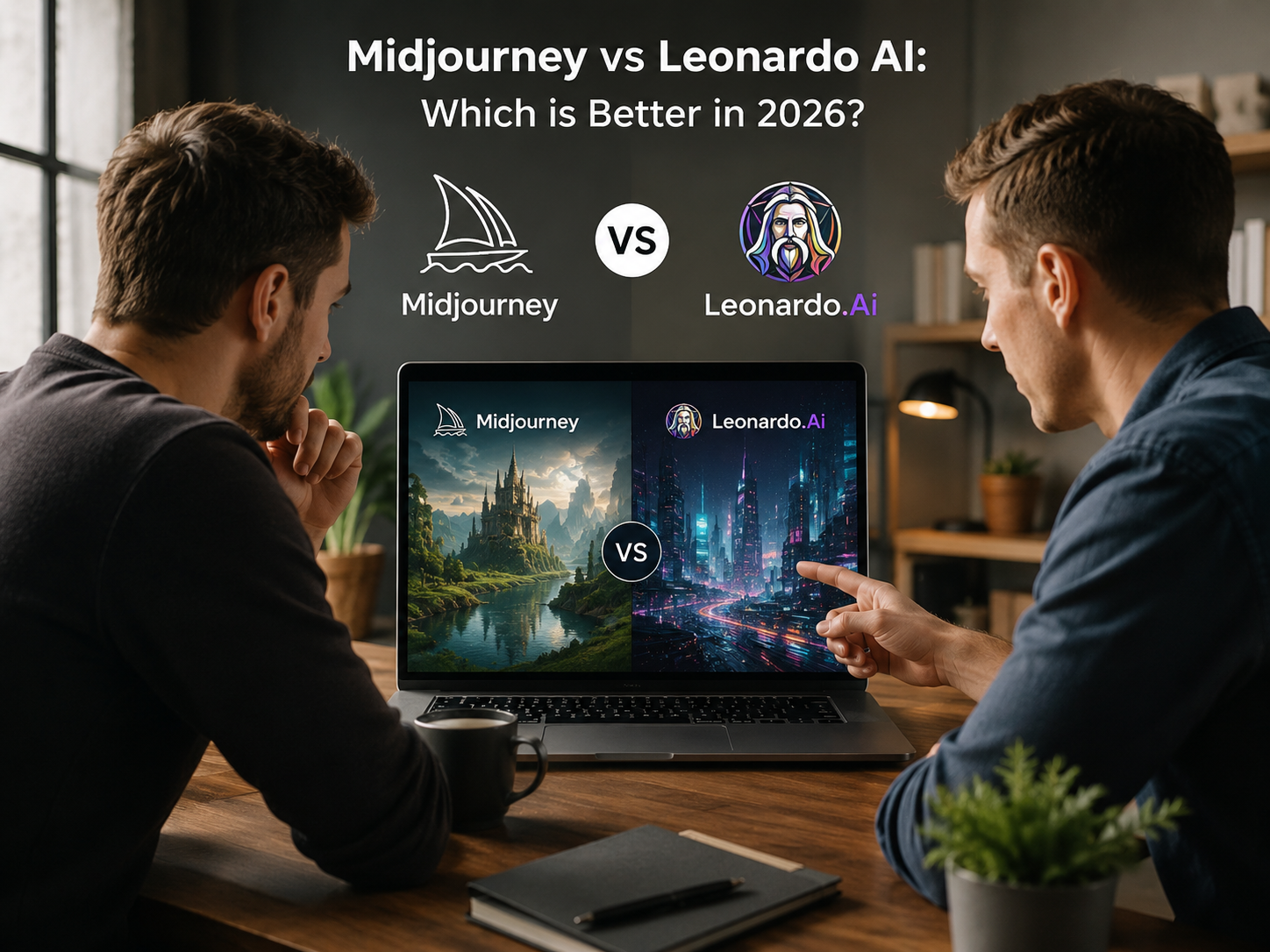
Midjourney vs Leonardo AI in 2026: Which is Actually Better?
Midjourney vs Leonardo AI is one of the most searched AI tool comparisons of 2026 — both tools are strong, but built for different users. This comparison covers image quality, verified pricing, the free tier reality, ease of use, and the limitations neither tool advertises, plus a free interactive cost calculator.
📋 Table of Contents
- Quick Overview: Both Tools
- Full Head-to-Head Comparison Table
- Round 1 — Image Quality
- Round 2 — Ease of Use
- Round 3 — Free Tier
- Best Free Alternative to Midjourney in 2026
- Round 4 — Pricing (Verified)
- The Real Cost-Per-Image Math
- 🧮 Interactive Cost Calculator
- Round 5 — Features & Tools
- Midjourney vs Copilot’s Image Model vs Leonardo AI
- Midjourney vs Stable Diffusion vs Leonardo AI
- Why The Same Prompt Gives Different Results
- Same-Prompt Visual Test
- Myth vs Reality
- Do You Need Both?
- Final Verdict & Scorecard
- Advanced: Running Both as One Pipeline
- Where Both Tools Quietly Fail
- What Happens When You Cancel
- Platform Risk: Flagging & Demonetization
- Frequently Asked Questions
Quick Overview: Midjourney vs Leonardo AI
Before the full breakdown, here is what each tool is and who it is designed for — in plain English, not marketing language.
Midjourney launched in 2022 and became known for one thing: cinematic, artistic AI images that feel dramatic and visually polished even from short prompts. It runs through its own web app (Discord is no longer required). There is no free plan or trial in 2026 — Midjourney removed it in March 2023. Cheapest entry point: Basic plan at $10/month.
Leonardo AI is designed for creators who want control, not just beauty. Multiple AI models, a Canvas editor with inpainting/outpainting, character consistency, video generation, and a genuinely usable free tier with 150 daily tokens. Entirely browser-based. Free plan available, paid plans (Essential, Premium, Ultimate) start at $12/month. Confirm current pricing at leonardo.ai/pricing.
Full Head-to-Head Comparison: Midjourney vs Leonardo AI 2026
👉 Swipe to see all columns
| Category | 🟣 Midjourney | 🔵 Leonardo AI |
|---|---|---|
| Free Plan | ❌ No free plan or trial | ✅ 150 free tokens daily — no expiry |
| Starting Price | $10/month (Basic) | $0 (Free) / $12/month (Essential) |
| Artistic Image Quality | 🏆 Strong cinematic, stylized look | Strong — especially Phoenix & Lucid models |
| Photorealistic & Prompt Adherence | Good | 🏆 Phoenix model built for prompt accuracy |
| Ease of Use | Moderate — command syntax learning curve | 🏆 Beginner-friendly visual dashboard |
| Image Editing Tools | Limited (Vary, Remix, Zoom Out/Pan) | 🏆 Full Canvas editor — inpainting, outpainting |
| AI Models Available | Single core model line (V7 default) | Multiple — Phoenix, Lucid, Flux family, more |
| Custom Model Training | ❌ Not available | ✅ LoRA training on paid plans |
| API Access | Limited | Pay-as-you-go Production API |
| Private Images | Pro plan only ($60/mo) | Available on entry paid plan ($12/mo) |
| Video Generation | Yes — image-to-video (paid) | Yes — Motion video (free + paid) |
| Team Plans | ❌ Not offered | ✅ Team Starter $72/mo, Team Growth $144/mo (3 seats each) |
| Community | 🏆 Large, established Discord community | Growing community + public gallery |
| Best For | Artists, creatives, aesthetic-first users | Beginners, businesses, content creators |
Round 1 — Image Quality
Both tools produce excellent images — but with fundamentally different default styles.
Midjourney is widely regarded as the leader in artistic aesthetics. Even short, basic prompts return cinematic, dramatic, gallery-worthy images. It excels at atmospheric moods, epic landscapes, surreal compositions, and painterly textures. Type “luxury perfume ad in soft golden light” and Midjourney impresses on the first try.
Leonardo AI wins on photorealism and prompt accuracy, largely thanks to its Phoenix 1.0 model — built specifically for prompt adherence. For commercial content, product shots, character consistency, and social media visuals, Leonardo produces cleaner, more literal results faster.
Cinematic compositions, moodboards, fantasy art, fashion concepts, and creative projects where visual impact matters most
Product photography, portraits, social media content, consistent characters, and any work that needs to look real and usable
Round 2 — Ease of Use
This round is a clear win for Leonardo AI. Midjourney now has its own full web app — Discord is no longer required — but its command-based prompt syntax (--stylize, --chaos, --ar) still has a learning curve. Images on Basic/Standard plans are public by default; private generation (Stealth Mode) requires the Pro plan ($60/month).
Leonardo AI has a clean, visual dashboard most people figure out within minutes. No Discord, no command syntax. Everything is labeled clearly, and the community gallery shows exact prompts used by other creators.
✅ Leonardo AI Ease of Use Pros
- Clean browser dashboard — no Discord ever
- All settings visually labeled
- Community gallery shows prompts for every image
- Works well on mobile browser
- No command syntax to learn
⚠️ Midjourney Ease of Use Cons
- Command/parameter syntax has a learning curve
- Free images on Basic/Standard plans are public
- Stealth Mode (private) requires $60/mo Pro plan
- No free trial to test before paying
Winner: Leonardo AI — by a significant margin for beginners. See our full guide on how to use Leonardo AI step by step to get started in under 10 minutes.
Round 3 — Free Tier
This round is not close. Midjourney has no free plan or trial in 2026 — it removed its trial in March 2023. The one exception: a limited trial via Midjourney’s niji·journey mobile app (iOS/Android). For the main web experience, you pay from day one, starting at $10/month.
Leonardo AI gives you 150 free tokens every 24 hours with no expiry date on the free plan. Tokens reset daily and don’t roll over on the free tier. Token cost varies by model and settings — treat 150 tokens as a daily budget, not a guaranteed image count. Published token math suggests roughly 20–30 standard-model images per day is a more realistic planning number than the higher estimates floating around online; one independently tested run burned through the full 150-token allowance in 22 generations. No credit card required. Limitation: free-tier creations are public, and Leonardo’s commercial terms are cleaner on paid plans.
Best Free Alternative to Midjourney in 2026
If Midjourney’s $10/month minimum is the blocker, here are the three most practical no-cost options, ranked by what they actually give you:
🥇 Leonardo AI — Best Overall
150 free tokens daily, no credit card, 10+ AI models, Canvas editor, video generation. The Phoenix model handles artistic prompts well; Lucid Realism handles photorealistic content. This is the closest thing to Midjourney’s quality without paying a cent.
🥈 Microsoft Copilot — Best for Quality with Minimal Friction
If you have a Microsoft account (Windows, Xbox, Outlook), you already have access to free image generation at copilot.microsoft.com — 15 fast generations per day plus unlimited slower-speed generation after that. One thing worth correcting here: this is no longer DALL-E 3. OpenAI retired DALL-E 3 on May 12, 2026, and Copilot now runs a newer OpenAI image model (Microsoft doesn’t publish exactly which version powers each Copilot surface). Output quality is still strong — comparable to or better than the old DALL-E 3 baseline — and there’s no new signup for most users. See our full no-signup AI art generators guide for more.
🥉 Adobe Firefly — Best for Commercial-Safe Free Images
A free Adobe account gives roughly 25 free credits/month. Image quality is strong and it’s trained on licensed Adobe Stock content, making it the most legally defensible free option for commercial work — the trade-off is the tighter monthly allowance.
Round 4 — Pricing Compared (Verified September 2026)
Standard monthly prices shown below. Both platforms offer ~20% annual-billing discount. Always verify at each platform’s live pricing page before subscribing.
👉 Swipe to see all columns
| Plan | Midjourney | Leonardo AI |
|---|---|---|
| Free | ❌ Not available | ✅ 150 tokens/day, no expiry |
| Entry paid | Basic — $10/mo (3.3 Fast GPU hours) | Essential — $12/mo (8,500 tokens/mo, 25,500-token Rollover Bank) |
| Mid tier | Standard — $30/mo (15 Fast GPU hrs + unlimited Relax) | Premium — $30/mo (25,000 tokens/mo, 75,000-token Rollover Bank) |
| Top individual | Pro — $60/mo (30 Fast GPU hrs + Stealth Mode) | Ultimate — $60/mo (60,000 tokens/mo, 180,000-token Rollover Bank) |
| Highest tier | Mega — $120/mo (60 Fast GPU hrs) | Team Starter $72/mo or Team Growth $144/mo (3 seats each) |
| Private images | Pro plan only ($60/mo) | Essential and above ($12/mo) |
| Annual discount | ~20% off — effective ~$8/$24/$48/mo | ~20% off across all paid tiers |
The Real Cost-Per-Image Math
Sticker price is the least useful number here. What matters is cost per finished, usable image — after factoring in rejected generations, re-rolls, and upscales.
👉 Swipe to see all columns
| Scenario | Midjourney Reality | Leonardo AI Reality |
|---|---|---|
| What you’re billed for | Fast GPU time (minutes/hours), not a flat image count | Tokens, which vary in cost by model and quality setting |
| Rejected generations | Still consumed GPU time already spent | Still consumed tokens already spent |
| What happens when you run out | Basic: stops (or pay ~$4/hr overage). Standard+: drops to slower Relax mode. | Free: stops until daily reset. Paid: Relaxed Generation on own models, or buy a top-up. |
| Hidden cost driver | Stealth Mode requires jumping to $60/mo Pro tier | Heavy models (and video) drain token balance faster than expected |
🧮 Interactive Cost-Per-Image Calculator Free Tool
Plug in your usage habits to estimate your real cost per finished image on each platform.
🟣 Midjourney
🔵 Leonardo AI
⚠️ Estimates only — Leonardo AI does not publish a fixed token-to-image conversion, and actual token cost varies by resolution and settings even within one model. Midjourney bills in GPU-minutes, not a flat image count. Use this for relative comparison, not as an exact quote.
Round 5 — Features and Creative Tools
🟣 Midjourney Features in 2026
- V7 — current default model; strong aesthetic, high-resolution output
- Vary and Remix — generate variations of an existing image
- Zoom Out / Pan — extend an image beyond its original borders
- Style Reference — match the style of a reference image
- Image-to-Video — 5–21 second clips on paid plans
- Web App — Discord no longer required
🔵 Leonardo AI Features in 2026
- Multiple AI Models — Phoenix 1.0, Lucid Origin, Lucid Realism, Flux family, and more
- Canvas Editor — full inpainting and outpainting
- Image-to-Image — use any image as a reference or starting point
- Alchemy — rendering pipeline that enhances lighting and fidelity
- Consistent Character Engine — maintains character appearance across multiple images
- Universal Upscaler — increase image resolution with AI
- Motion Video Generation — generate short videos from stills
- Custom LoRA Training — train models on your own images (paid plans)
- Production API — pay-as-you-go pricing for automation, starting with a $5 non-expiring starter credit
- Real-time Canvas — renders images live as you sketch
- Team Plans — Team Starter ($72/mo) and Team Growth ($144/mo), each covering 3 seats with a shared token pool
Midjourney vs Copilot’s Image Model vs Leonardo AI — Which Wins?
The real question in 2026 isn’t just Midjourney vs Leonardo — it’s how both stack up against Microsoft Copilot’s free image tool as a third option. One correction worth flagging up front: this used to be a straightforward “vs DALL-E 3” comparison, but OpenAI retired DALL-E 3 on May 12, 2026. Copilot now runs a newer OpenAI image model instead — Microsoft doesn’t publish exactly which version powers each surface, so treat “Copilot’s current model” as the accurate label rather than “DALL-E 3” if you see that term used elsewhere.
Verdict: for pure artistic quality, Midjourney still edges Copilot’s current model, but its free access is hard to beat for casual use. Leonardo AI wins overall because it offers quality close to both, with more editing tools and a genuine free plan with daily resets.
Midjourney vs Stable Diffusion vs Leonardo AI
This comes down to one trade-off: ease of use and out-of-the-box quality versus cost and control.
Verdict: Midjourney is better if you want fast, great results with no technical setup. Stable Diffusion is better for full control and unlimited free generation if you don’t mind installing software. Leonardo AI sits in the middle — multiple models and real editing tools without any local setup, which makes it the better starting point for most beginners over Stable Diffusion.
Why The Same Prompt Gives Different Results Deep Dive
Type the exact same prompt into Midjourney and Leonardo AI and you will not get “the same image in a different style” — you’ll often get a fundamentally different interpretation. Here’s why:
- Midjourney leans toward its house aesthetic by default. Plain prompts often get pulled toward Midjourney’s signature cinematic look whether you asked for that mood or not.
- Leonardo’s behavior depends heavily on which model is active. The same prompt on Phoenix, Lucid Origin, Lucid Realism, or a Flux-family model produces different results — these are different underlying models, not style filters.
- Negative prompting works differently on each. Leonardo has a dedicated negative prompt field that reliably excludes elements. Midjourney relies on
--noand prompt-weighting, which can be inconsistent. - Multi-subject prompts stress both tools. Two distinct subjects in a scene can cause feature blending on either platform.
- Aspect ratio changes affect composition, not just cropping. Changing the ratio on either platform changes what the model decides to compose within that frame.
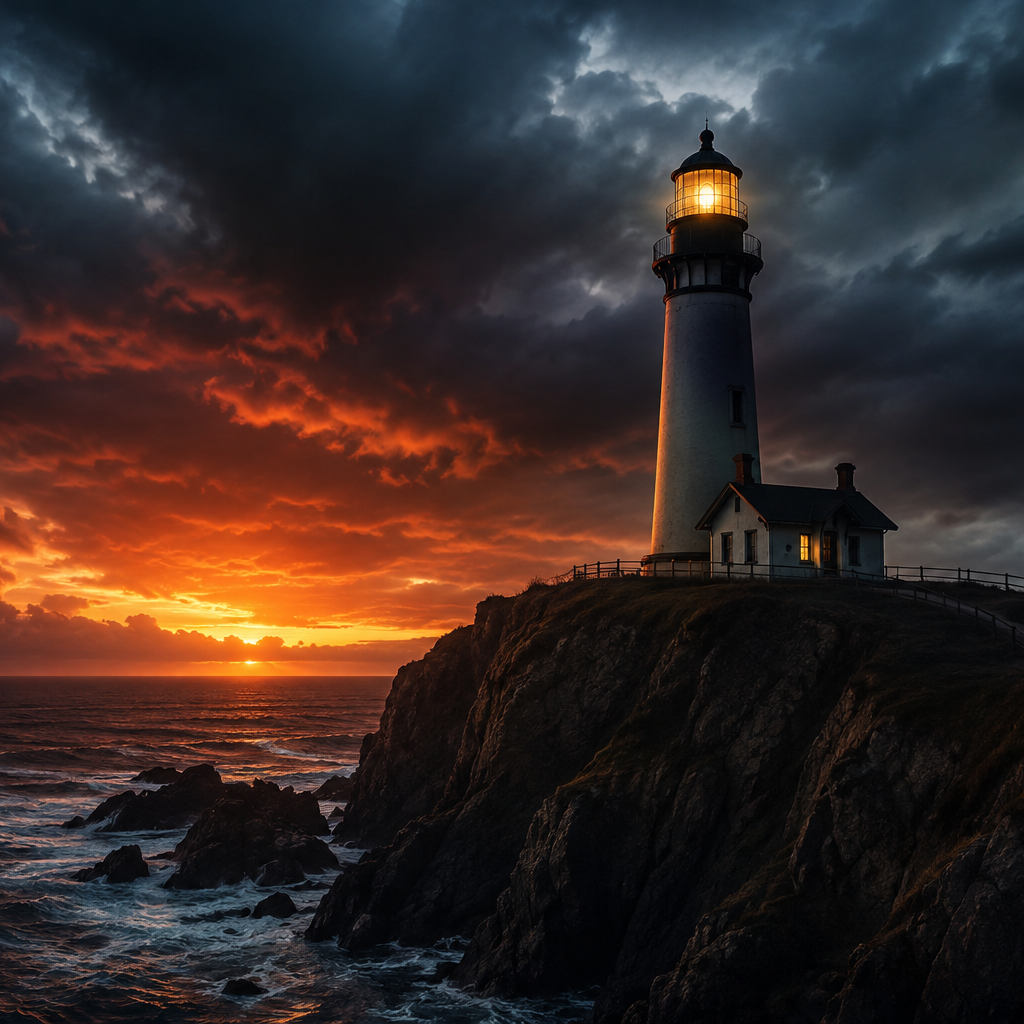
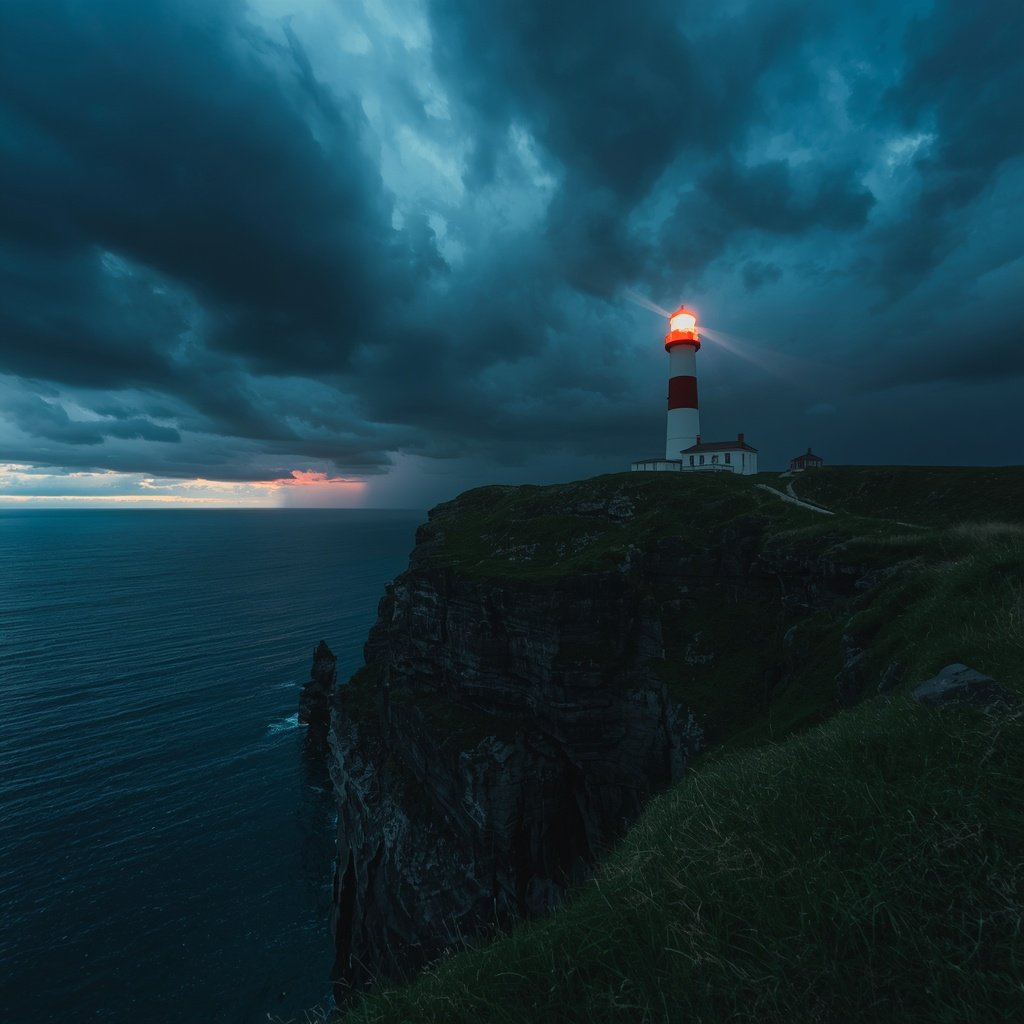
See It Yourself: A Same-Prompt Visual Test Real Screenshots
Test Prompt 1 (artistic/stylized):
Test Prompt 2 (photorealistic/commercial):


Test Prompt 3 (multi-subject stress test):


Myth vs Reality: What the Internet Gets Wrong
👉 Swipe to see all columns
| ❌ The Myth | ✅ The Reality |
|---|---|
| “Leonardo’s free tier is enough to replace paid tools entirely for a small business.” | It’s genuinely strong for casual social content, but breaks down for consistent branding, private generations, or daily volume — those require a paid plan. |
| “More AI models available automatically means better results.” | Model sprawl on Leonardo can cause decision paralysis and inconsistent visual style unless you lock to one model per project. |
| “Midjourney’s legal controversy means you shouldn’t use it commercially at all.” | The actual exposure depends heavily on use case, scale, and jurisdiction. Review current terms rather than relying on headlines. |
| “Stealth/Private mode means full ownership and legal protection.” | Stealth mode only controls visibility — it does not change underlying licensing. Visibility and legal rights are two separate things. |
| “Leonardo’s free tier means you fully own your images, same as paid.” | On the free tier, Leonardo retains rights to use, reproduce, and distribute your creations. Full ownership requires a paid plan. |
| “Microsoft Copilot’s free image tool is DALL-E 3.” | Not anymore — OpenAI retired DALL-E 3 on May 12, 2026. Copilot now runs a newer OpenAI image model, and this is still one of the most underused free Midjourney alternatives in 2026 even under its correct current name. |
Do You Need Both? A 3-Question Redundancy Check
- Do you need both rapid creative ideation AND precise, editable production assets? If your workflow genuinely needs both stages, two tools earns its cost back quickly. If you only need one, pick the tool that covers it.
- Is your current tool failing you on a specific, recurring task? A vague “more options” reason rarely justifies a second subscription. A specific recurring failure usually does.
- Can you justify the cost against your output volume? If you’re producing fewer than 20–30 images per month, the free tiers and a single low-cost plan will almost always cover you.
Final Verdict & Scorecard — Midjourney vs Leonardo AI 2026
👉 Swipe to see all columns
| Category | 🟣 Midjourney | 🔵 Leonardo AI |
|---|---|---|
| Image Quality (Artistic) | 9/10 | 8/10 |
| Image Quality (Photorealism) | 7.5/10 | 9/10 |
| Ease of Use | 6.5/10 | 9/10 |
| Free Tier / Entry Value | 3/10 | 9/10 |
| Editing Tools | 5.5/10 | 9/10 |
| API / Automation | 4/10 | 8.5/10 |
| Community | 9/10 | 6.5/10 |
| CrixPix Average Score | 6.4/10 | 8.4/10 |
Scores are CrixPix’s own editorial assessment based on hands-on testing, not an official benchmark from either platform.
🟣 Choose Midjourney If…
- You want strongly artistic, cinematic images with minimal prompt effort
- You are creating portfolio pieces, moodboards, concept art, or album artwork
- Image style is your top priority and budget is secondary
- You value Midjourney’s large, established creative community
- You’re comfortable paying $10/month minimum with no free trial first
🔵 Choose Leonardo AI If…
- You want to start completely free with no credit card
- You need a genuinely powerful free option, not a crippled demo
- You need realistic, production-ready images for blogs, social media, or marketing
- You want full editing tools — inpainting, upscaling, canvas editor
- You need consistent character designs across multiple images
- You want private image generation without paying $60/month
- You are a beginner who wants an easy workflow
🏆 Overall Verdict: Leonardo AI Wins for Most Users in 2026
For the majority of users — especially beginners, content creators, bloggers, and small businesses — Leonardo AI is the better choice in 2026. The genuine free tier, cleaner interface, broader editing tools, and lower-cost path to private commercial generation make it the more practical platform. Midjourney remains a strong choice if its specific artistic look matters most and you’re comfortable paying from day one.
Advanced: Running Both as One Production Pipeline Advanced
Experienced teams don’t choose a winner — they run both tools as stages in a single pipeline.
Concept in Midjourney
Generate moodboards and creative direction where aesthetic impact matters most. Export the strongest concepts as reference images.
Refine in Leonardo Canvas
Use the exported concept as a style/content reference. Inpaint, correct brand colors, and adjust composition with full editing control.
Upscale & Deliver
Run the Universal Upscaler for final delivery resolution. Apply a unifying color grade across the batch before export.
Where Both Tools Quietly Fail
👉 Swipe to see all columns
| Task | The Problem | Workaround |
|---|---|---|
| Exact brand color matching | Both tools drift from precise hex values even with a reference image | Generate, then correct colors manually in a separate editor before delivery |
| Consistent lighting across a series | Subtle drift appears past 3–4 images even with identical prompts | Batch color-grade the full set as a final unifying pass |
| Transparent backgrounds | Neither tool generates clean transparency natively | Generate on solid background, then use a dedicated background-removal tool |
| Exact ad-platform dimensions | Native aspect ratios rarely match precise pixel requirements for ad placements | Generate close to the target ratio, then crop/extend carefully |
| Hands, fine text, technical diagrams | Both tools still fail enough on hands and precise detail to be unreliable for client deliverables | Default to manual design tools for these elements rather than retrying endlessly |
What Happens When You Cancel
- Already-downloaded images remain yours — cancellation doesn’t retroactively revoke files on your device.
- Cloud generation history access may become limited after downgrading or cancelling — don’t rely on the platform as your only backup.
- Leonardo top-up tokens specifically don’t expire when you cancel, but they become unusable until you resubscribe — a genuinely easy-to-miss detail if you’re planning to pause and come back later.
- Re-subscribing later typically restores account history access, but treat any gap as a risk window — download everything before you cancel.
- Commercial rights already granted on images generated during a commercial-eligible plan are generally not retroactively revoked on cancellation — but verify current terms for your specific use case.
Platform Risk: Will Social Platforms Flag AI Images?
- AI-content disclosure policies are spreading across major social platforms. Check current policy on any platform you post to before relying on undisclosed AI imagery for monetized content.
- Undisclosed use is the bigger risk than AI origin itself. Honest disclosure where required reduces risk significantly.
- Monetization eligibility can differ from posting eligibility — a platform may allow AI images while restricting creator fund or ad eligibility on content that doesn’t meet disclosure requirements.
- For client work, confirm the destination platform’s current AI-content policy as part of project scope, not as an afterthought.
Frequently Asked Questions — Midjourney vs Leonardo AI
Is Leonardo AI better than Midjourney in 2026?
For most users, yes — a genuine free plan, more editing tools, and an easier workflow. Midjourney produces more stylized, cinematic images but has no free plan and starts at $10/month.
Does Midjourney have a free plan in 2026?
No, not on the main web app — Midjourney removed its free trial in March 2023. A limited trial exists on the niji·journey mobile app. The core web experience starts at $10/month.
What is the best free alternative to Midjourney in 2026?
Leonardo AI is the closest match on quality and tools. Microsoft Copilot gives free access to its current image model if quality matters most — note this is no longer DALL-E 3, which OpenAI retired in May 2026. Adobe Firefly suits commercial-safe work on a tighter allowance. Full breakdown in the section above.
Which is easier to use — Midjourney or Leonardo AI?
Leonardo AI, significantly — a clean dashboard, no Discord, no command syntax. Midjourney’s web app has improved but its parameter system still has a learning curve.
Can I use Midjourney or Leonardo AI images commercially?
Both allow commercial use on paid plans. Midjourney requires companies over $1M gross annual revenue to use Pro or Mega. Leonardo AI paid subscribers retain full ownership; free-tier images carry more limited rights. Always check current terms.
Does Leonardo AI have an API that Midjourney doesn’t?
Yes — an official pay-as-you-go Production API. Midjourney’s API access remains limited, which matters most for bulk or automated workflows.
What happens to my images if I cancel my subscription?
Images you’ve already downloaded remain yours. Continued access to your cloud generation history may be reduced after cancellation, and on Leonardo specifically, any leftover top-up tokens become unusable until you resubscribe — download everything before you cancel, not after.
🚀 Ready to Start? Here’s the Fastest Path
Start free today: Go to leonardo.ai — no credit card, 150 free tokens daily.
Want strong free quality fast? Try Microsoft Copilot (its current image model, 15 fast/day, no new account needed if you have a Microsoft login).
Bookmark CrixPix.com for daily, honest AI tool reviews updated for 2026.