Perplexity vs ChatGPT: Which One Actually Deserves Your $20 in 2026?
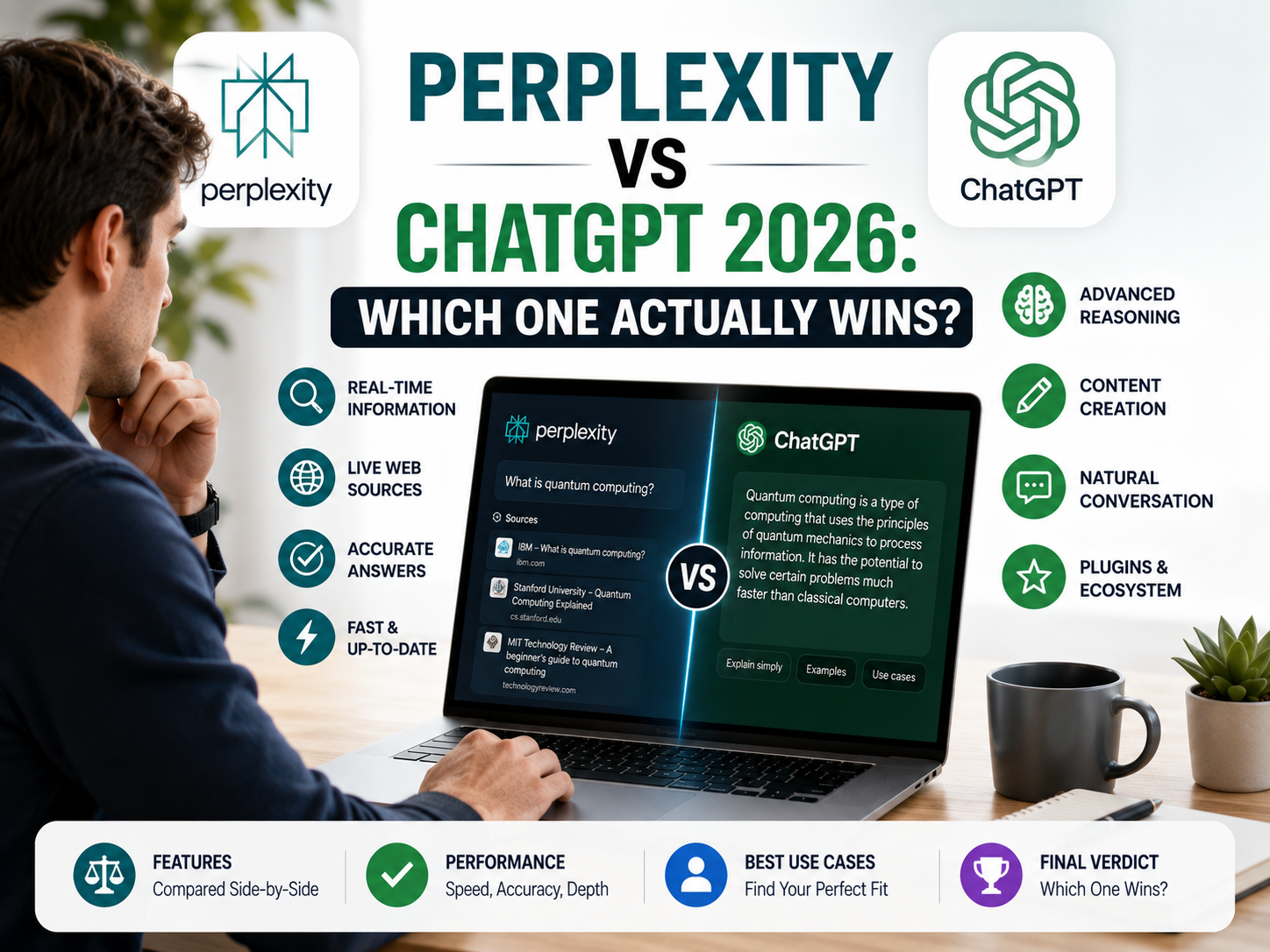
Somewhere along the way, “just Google it” quietly turned into “just ask an AI.” Perplexity and ChatGPT are the two names that come up most when people make that switch, and both are happy to answer almost anything you throw at them with a straight face.
The problem is that a straight face isn’t the same as a correct answer. One of these tools was built to search the live web and show its work. The other was built to think, write, and create, and it searches the web only when you ask it to. Mixing the two up is how you end up quoting an AI that made something up with total confidence.
This isn’t a spec-sheet skim — it’s a look at what each tool is actually built to do, and where that shows up in daily use. Let’s get into it.
How this comparison was put together: pricing and plan features were checked directly against Perplexity’s official pricing page (perplexity.ai/hub/pricing) and OpenAI’s official ChatGPT pricing page (chatgpt.com/pricing) as of August 2026. Numbers move fast in this space, so always confirm the live pricing page before you subscribe.
What Is Perplexity AI?
Perplexity is best described as a search engine with an AI narrator attached to it. Type a question, and it runs a live web search, reads through the results, and writes you a summary with numbered citations sitting right next to every claim.
That citation habit is the whole point. Click a number, and you land on the actual source page instead of just trusting the AI’s word for it. For anyone who has been burned by a chatbot inventing a statistic, this alone is a reason to keep Perplexity around.
Perplexity also ships Comet, its own AI-agent browser, which has been free for every user since late 2025. It’s built for people who want an assistant that reads pages and books things for them, not just one that chats.
What Is ChatGPT?
ChatGPT, from OpenAI, is a general-purpose conversational AI. It writes, codes, brainstorms, edits documents, analyzes files, generates images, and — with browsing switched on — searches the web too. It just doesn’t lead with search the way Perplexity does; it leads with reasoning and generation.
By default, ChatGPT answers from its training knowledge and its own judgment about when a question needs a live search. That makes it faster and more flexible for creative or technical work, but it also means citations are the exception, not the rule.
Think of it this way: Perplexity hands you a research report with footnotes. ChatGPT hands you a finished draft and lets you decide whether you need footnotes at all.
Perplexity vs ChatGPT: Core Differences at a Glance
| Category | Perplexity | ChatGPT |
|---|---|---|
| Primary strength | Real-time, cited research | Writing, coding, creative work |
| Default behavior | Searches the live web every time | Answers from training data unless browsing is triggered |
| Citations | Numbered, inline, on by default | Only shown when browsing is used |
| Free tier | Unlimited basic search, capped Pro searches | Unlimited text chats on GPT-5.6 Luna; capped uploads, images, voice, and Deep Research; ads may appear on Free and Go in some regions |
| Unique tool | Comet AI browser (free) | Sora video, Codex coding agent, Agent Mode |
| Entry paid plan | Pro — $20/month | Plus — $20/month |
Notice the entry-level price is identical. That’s exactly why “perplexity pro vs chatgpt plus” is such a common search — at the same $20, you’re not picking the cheaper tool, you’re picking the tool built around a different job.
Perplexity vs ChatGPT Pricing in 2026
Both companies have added tiers this year, so the old “$20 or free” comparison is out of date. Here’s where things actually stand.
Perplexity Pricing
- Free — citations on every answer, access to Perplexity’s basic models, limited weekly usage of top-tier search
- Pro — $20/month — expanded Computer (agentic task) access, deep research, access to top AI models including ChatGPT, Gemini, Claude, and NVIDIA Nemotron with the option to pick a preferred model, 10x the file uploads and asset generation of Free, and the Comet browser agent
- Max — $200/month — everything in Pro with higher limits on deep research, asset generation, and file uploads, plus monthly Computer credits, more video generation, and periodic Model Council runs
- Enterprise Pro — $40/seat/month as of this writing; Perplexity also sells a higher Enterprise Max tier, and either can shift with a negotiated contract, so confirm current terms with sales before budgeting
ChatGPT Pricing
- Free — unlimited text chats on GPT-5.6 Luna, with limited uploads, image generation, voice, memory, and Deep Research
- Go — $8/month — more messages, uploads, image creation, voice, and longer memory than Free; may include ads in some regions
- Plus — $20/month — advanced reasoning with GPT-5.6, expanded Deep Research and memory, Projects, scheduled tasks, custom GPTs, and expanded Codex access
- Pro — from $100/month (5x or 20x usage tiers) — everything in Plus plus GPT-5.6 Sol Pro reasoning, maximum Codex tasks, unlimited faster image creation, and maximum Deep Research
- Business — $20/seat/month billed annually (roughly $25 on monthly billing) — shared workspace, admin controls, and team-level security features, minimum 2 seats
Research and Citations: Where Perplexity Wins
If your work depends on being able to defend a claim, Perplexity is the safer default. It shows its sources without being asked, which matters for students, marketers writing anything data-driven, and anyone who has had to explain to a boss why a stat was wrong.
Perplexity’s index also updates close to real time, so questions about current events, pricing, or fast-moving topics tend to come back fresher than a chatbot working from a browsing plugin.
There’s also a practical side benefit: because every claim links back to a source page, Perplexity doubles as a research shortcut. Instead of opening ten browser tabs and skimming each one, you get a synthesized answer plus the tab list already sorted by relevance. For long research sessions, that alone saves real time.
Neither tool is immune to mistakes, though. Perplexity can misread a source or cite a low-quality page just as easily as ChatGPT can state something confidently wrong. Citations make a claim checkable — they don’t make it automatically true. Click through before you repeat anything important, especially for numbers, medical information, or anything with legal weight.
When Citations Lie: The Hidden Failure Mode of “Source-Backed” Answers
Here’s the part most reviews skip: a citation next to a claim tells you the claim is checkable, not that it’s correct. I learned this the annoying way while researching the pricing section above — half a dozen “trusted” sources disagreed on Perplexity’s own Max plan price, each one citing something.
A few failure patterns are worth knowing before you trust a cited number blindly:
- Misattribution. The citation is topically close to the claim, not an exact match. The AI pulled a real source, but the specific number or line it’s backing up isn’t actually in that source.
- Syndication illusion. A press release gets copied across ten blogs. Perplexity cites three of them next to one claim, which looks like independent confirmation but is really one source wearing three coats.
- Stale cache. Pricing pages change often. If the AI’s crawl of a page is a few weeks old, the citation link is real and the number it shows you is already out of date.
- Clean formatting beats accurate content. Pages built specifically to be scraped and summarized — short paragraphs, clear headers, direct answers up top — often get picked up over a more accurate but messier source, simply because they’re easier for the retrieval layer to extract from.
The fix isn’t to distrust citations. It’s to treat them the way a good editor treats a source: click the top one or two for anything commercial or numeric, check the publish or update date, and prefer the primary source (the company’s own pricing page) over a third-party blog repeating it.
Writing, Coding, and Creativity: Where ChatGPT Wins
Ask either tool to write a 500-word article, and the difference shows up fast. ChatGPT tends to produce longer, more structured drafts with a consistent voice, because generation is its actual job. Perplexity’s answers read more like a briefing document — accurate, but built for scanning, not publishing as-is.
The same goes for code. ChatGPT’s Codex and its coding-focused reasoning modes are built for debugging and multi-step projects. Perplexity can explain code and pull documentation, but it isn’t trying to be a development environment.
Multimodal work tips the same way. ChatGPT’s Sora video generation, image tools, voice mode, and file analysis give it a wider creative range in one place.
There’s a memory factor too. ChatGPT carries context across a conversation and, on paid plans, across sessions, which makes it better suited to long, iterative projects like editing a full article draft over several rounds. Perplexity is built more around single, self-contained research queries, so it doesn’t try to be a long-running creative collaborator in the same way.
Perplexity Pro vs ChatGPT Plus: Same $20, Different Bet
Since both entry-level paid plans land at exactly $20 a month, this is the comparison most people actually care about before they pull out a credit card.
Perplexity Pro’s $20 buys expanded agentic Computer access, deep research, the ability to pick a preferred underlying model (ChatGPT, Gemini, Claude, or Nemotron), and the Comet browser agent. You’re paying for depth and speed of research, plus the flexibility to choose which model answers a given query.
ChatGPT Plus’s $20 buys the full flagship model, Deep Research runs, Sora video generation, Codex for coding, and Agent Mode. You’re paying for breadth — one subscription that covers writing, coding, and multimedia generation in a single tool.
Neither $20 is wasted money. It genuinely comes down to whether your week looks more like “find and verify information” or “create and iterate on content.” If you’re not sure, most free tiers are generous enough to test both for a week before deciding.
The Model-Switching Trap Inside Perplexity Pro
This section assumes you already know the basics above — it’s for anyone actually paying for Perplexity Pro, not someone deciding whether to sign up.
Most reviews talk about “Perplexity” as if it’s one consistent experience. It isn’t, by Perplexity’s own account: the company describes itself as orchestrating multiple top models — ChatGPT, Google Gemini, Anthropic Claude, and NVIDIA Nemotron among them — and auto-selecting the best one per query on Free. Pro and Max add the ability to pick a preferred model yourself instead of leaving it on auto.
A few things worth knowing if you’re on Pro or Max:
- Because model selection happens per query, two questions asked minutes apart can genuinely be answered by two different underlying models — that’s confirmed behavior, not speculation.
- Different foundation models are generally understood to vary in how closely they stick to source material versus how much they extrapolate. Perplexity doesn’t publish a breakdown of exactly how each model behaves inside its retrieval layer, so treat this as an informed expectation rather than a documented fact — worth testing yourself on a query that matters.
- The Sonar API, used by developers building on Perplexity, is a separate product from the consumer app. Reviews and accuracy claims about the consumer app don’t automatically carry over to an API integration.
- If answer quality feels inconsistent week to week on Pro or Max, checking which model is set to run — rather than assuming “Perplexity” is unreliable as a brand — is a reasonable first troubleshooting step, since auto-selection is a real, confirmed feature.
The practical takeaway: Perplexity is officially a retrieval layer sitting on top of a rotating set of models, not one fixed product. What that means for any individual answer’s accuracy is worth testing rather than assuming.
Getting Cited: How Perplexity and ChatGPT Actually Choose Sources
If you run a website rather than just use these tools, this part is the one that affects your traffic.
Ranking on Google and getting cited by an AI engine are two different games now, and almost no comparison article mentions it because most are written for consumers, not publishers.
| Factor | Perplexity (Sonar) | ChatGPT (browsing) |
|---|---|---|
| Index source | Its own live web search, confirmed on Perplexity’s pricing and product pages | Historically built on Bing’s index; OpenAI hasn’t published the current source in detail, so treat this as likely rather than confirmed for 2026 |
| Citation behavior | Cites by default, often several sources per answer | Cites only when browsing or search is used, typically fewer sources |
What actually correlates with getting picked up is less documented than a classic SEO ranking factor. The row above states what’s confirmed; the rest of this section is reasoned analysis, not a published algorithm from either company.
The practical result: a page can sit at position 3 on Google and still never get picked up by either AI engine, because classic SEO signals like backlinks and domain age aren’t the whole story for AI retrieval the way they are for a traditional search ranking.
Based on how these retrieval systems are generally understood to work, a few structural choices are reasonable bets for improving citation odds — worth testing on your own content rather than treating as guaranteed:
- A direct, self-contained answer in the first 100–150 words, before the caveats and nuance
- Clear H2/H3 structure that maps to the actual questions people ask, not marketing language
- Genuinely updated content — a page revised last week beats a “2026” title tag with 2025 numbers still inside it
- Schema and structured FAQ blocks, which give the retrieval layer an easier chunk to lift
The bigger shift: Generative Engine Optimization (GEO) is becoming its own discipline, separate from classic SEO. Being #1 on Google no longer guarantees a citation in an AI Overview or a Perplexity answer — and the reverse is just as true.
Perplexity vs ChatGPT vs Claude: Where Does a Third Option Fit?
You’ll notice both Perplexity Pro and ChatGPT now give you access to Claude models inside their own interfaces, which is part of why “perplexity vs chatgpt vs claude” shows up so often in search. In practice, Claude is generally considered the strongest of the three for long-document analysis and careful, cautious writing. If that’s your main need, our Claude AI walkthrough is worth a look before you commit to a subscription.
Which One Should You Actually Use?
Pick based on what you do most, not on which tool has the louder marketing.
- Students and researchers: Perplexity, for citations you can hand in with a paper
- Marketers and SEO writers: ChatGPT for drafting, Perplexity for fact-checking the draft
- Developers: ChatGPT, for Codex and iterative debugging
- Financial or fast-moving research: Perplexity, for freshness and sourcing
- Everyday casual use: either free tier works; go Perplexity if you want sources front and center
Plenty of people I know just run both. Perplexity finds and verifies the facts, ChatGPT turns them into something readable. It’s not cheating — it’s using each tool for the one thing it’s actually best at.
Enterprise and Team Deployment Realities
Advanced section — skip this if you’re deciding between the two as an individual. This is for anyone rolling either tool out to a team.
The plan price on the pricing page is rarely the real cost once a team is involved. The patterns below reflect general enterprise SaaS and AI-rollout behavior seen across the industry, not confirmed internal data from Perplexity or OpenAI — treat this as a risk checklist to verify against your own rollout, not a documented fact about either product.
| Failure pattern | Why it happens | Mitigation |
|---|---|---|
| Compliance exposure | Live web retrieval can pull from unvetted third-party sources mid-answer, which is a real problem in finance, healthcare, or legal work | Look for domain allow-lists or retrieval restrictions on enterprise tiers before rollout, not after |
| Shadow AI usage | Official enterprise accounts often gate features (like Comet or certain models) that employees relied on with their personal accounts, so they quietly keep using the personal version | Audit actual usage against the official rollout, not assumed usage |
| API cost surprises | Flat per-seat pricing looks predictable, but heavy Deep Research or Sonar API usage bills per token and can exceed subscription costs fast | Model expected query volume before committing to API-heavy workflows |
| Unstable citation formatting | Consumer-facing citations aren’t delivered in a consistent, structured format, so piping “answer plus sources” into a CMS or report needs custom engineering | Budget engineering time, not just subscription cost, for automated workflows |
| Memory lock-in | ChatGPT’s persistent memory across sessions becomes genuinely valuable over months, making a later switch costlier than the subscription price suggests | Factor accumulated context into any future vendor-switch decision |
None of this means either tool is a bad choice at scale. It means the sticker price is the smallest number in the actual decision once compliance, engineering time, and switching costs enter the picture.
Myth vs Reality: What Most Comparison Articles Get Wrong
| Myth | Reality |
|---|---|
| Perplexity never hallucinates because it cites sources | It can still misattribute or over-summarize a real source. Citations reduce hallucination risk, they don’t remove it. |
| ChatGPT can’t search the web | It can, through browsing and Deep Research. It just doesn’t do it on every message by default. |
| More citations always mean more accuracy | Several citations can trace back to one syndicated press release, creating an illusion of independent confirmation. |
| Perplexity Pro and ChatGPT Plus at $20 are basically interchangeable | Same price, genuinely different jobs — one optimizes for retrieval and sourcing, the other for generation and creation. |
| Testing the free tier tells you what the paid tier is like | Free tiers usually cut the exact features (Pro search depth, file uploads, image generation) that define the paid experience. |
| A benchmark accuracy score applies to every type of question | Accuracy gaps concentrate in fast-moving domains like finance; they’re far smaller on stable, well-documented topics. |
| Picking “Claude” or “GPT-5” inside Perplexity is the same as using that model directly | It’s the model constrained by Perplexity’s retrieval and citation layer, not the standalone product — behavior can differ. |
Frequently Asked Questions
Is Perplexity better than ChatGPT?
Not universally — it depends on the task. Perplexity is generally considered better for real-time, cited research. ChatGPT is generally considered better for writing, coding, and creative work. Neither one wins across every use case.
How is Perplexity different from ChatGPT?
Perplexity is built around live web search with inline citations on every answer. ChatGPT is a general-purpose conversational AI that answers from its training knowledge first and searches the web only when browsing is triggered.
What is Perplexity AI good for?
Perplexity is best for research that needs sources: fact-checking, current events, academic research, and any question where you need to verify where an answer came from.
Does Perplexity use ChatGPT?
No, they’re separate products from separate companies. However, Perplexity’s paid Pro and Max plans do let you select OpenAI’s GPT models (alongside Claude and others) as the underlying model for a search, so you can technically get GPT-powered answers inside Perplexity’s citation-first interface.
Is Perplexity AI better than ChatGPT for research?
For research specifically, yes, most comparisons favor Perplexity because of its default citations and near-real-time web index. For writing and general tasks, ChatGPT tends to come out ahead.
How does Perplexity AI differ from Google or ChatGPT?
Google returns a list of links for you to read yourself. ChatGPT generates an answer from its own reasoning, searching the web only when asked. Perplexity sits between the two: it searches like Google but reads and summarizes the results like ChatGPT, then shows you exactly where each part of the answer came from.
Is Perplexity AI good in 2026?
Yes, particularly for its intended purpose. It’s a genuinely strong research and fact-checking tool, and its free tier remains one of the more generous ones among AI search products. It’s just not designed to replace a full creative or coding assistant.
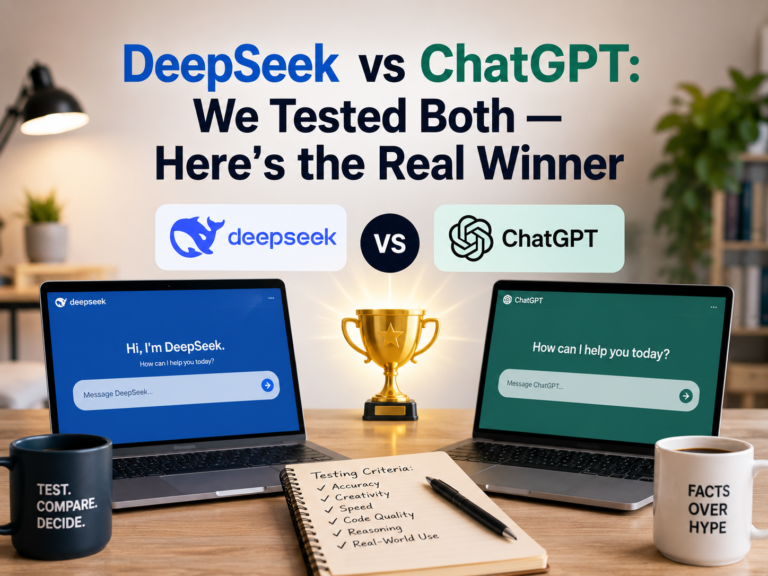
Want to see how the pricing math compares to other assistants? Our ChatGPT vs Grok comparison and DeepSeek vs ChatGPT breakdown cover two more angles on the same $20-a-month question. You can browse every head-to-head we’ve published in AI Tool Comparisons.


One Comment