Replit vs Lovable (2026): Or Should You Use Both?
Two years ago, describing an app out loud and watching it appear on screen sounded like a magic trick. In 2026, it’s just Tuesday. Replit and Lovable are the two names builders reach for most when they want AI to actually build the thing, not just autocomplete a function name.
They get talked about like rivals fighting for the same seat. In practice, they’re closer to two different tradespeople showing up for two different jobs. One hands you a fully wired coding environment with an AI that debugs like a colleague who never sleeps. The other hands you a polished, working app from a paragraph of plain English, no terminal in sight.
Mixing them up costs real time. Ask Lovable to handle a database migration and you’ll get a good-looking dead end. Ask Replit to turn a vague mood board into a landing page and you’ll get functional code that looks like it shipped in 2014. Let’s sort out which one actually fits your project.
How this comparison was put together: pricing was checked directly against Replit’s official pricing page (replit.com/pricing) and cross-verified for Lovable against multiple independent 2026 pricing trackers, since Lovable’s own page renders its plan prices via JavaScript. Company valuation and revenue figures come from Bloomberg, Forbes, and each company’s own announcements. Details current as of August 2026 — always confirm live pricing before you subscribe.
What Is Replit?
Replit started life as a browser-based code editor and grew into a full AI-first development platform. Its AI layer, Agent, can scaffold a Node.js server, wire up a database, and debug its own mistakes in a loop — closer to how a human developer actually works than a simple code-completion tool.
By its own account, Replit now has over 50 million users, counts 85% of the Fortune 500 among its builders, and ships Agent 4, which runs parallel agents on a single project. If your project needs custom logic, a specific database structure, or genuinely complex backend work, this is where that room to build lives — you can read the code, edit it directly, and let Agent debug in a loop when something breaks. Replit also isn’t locked into one tech stack; whatever language or framework a project needs, its cloud IDE can generally handle it, with a built-in database and deployment baked in from the start.
What Is Lovable?
Lovable is a Stockholm-based, prompt-to-app builder founded in 2023 by Anton Osika and Fabian Hedin. You describe what you want in plain language, and Lovable generates a working React app with a Supabase backend, authentication, and a database — no code editor required, though one is available if you want it.
The company has grown at a pace that’s genuinely rare in software: roughly 8 million users as of early 2026, and a business built around a credit system rather than seats or hours. Design output is where Lovable is consistently reported to stand out — reviewers and comparison sites across the space describe its generated layouts as notably more polished out of the box than what a code-first tool produces by default. For someone with zero coding background, the chat-first workflow removes the intimidation factor entirely: no terminal, no package manager, no cryptic error message to decode. You describe the change you want, and Lovable makes it.
Replit vs Lovable: Core Differences at a Glance
| Category | Replit | Lovable |
|---|---|---|
| Primary strength | Code control, debugging, full dev environment | Speed, design polish, non-technical use |
| Interface | Code editor, terminal, database, Agent chat | Chat-first, with an optional code editor |
| Best for | Developers who want to see and shape the code | Founders and designers who want a working app fast |
| Output stack | Flexible — any language, integrated database | React frontend + Supabase backend by default |
| Billing model | Subscription plus usage credits | Subscription plus per-message credits |
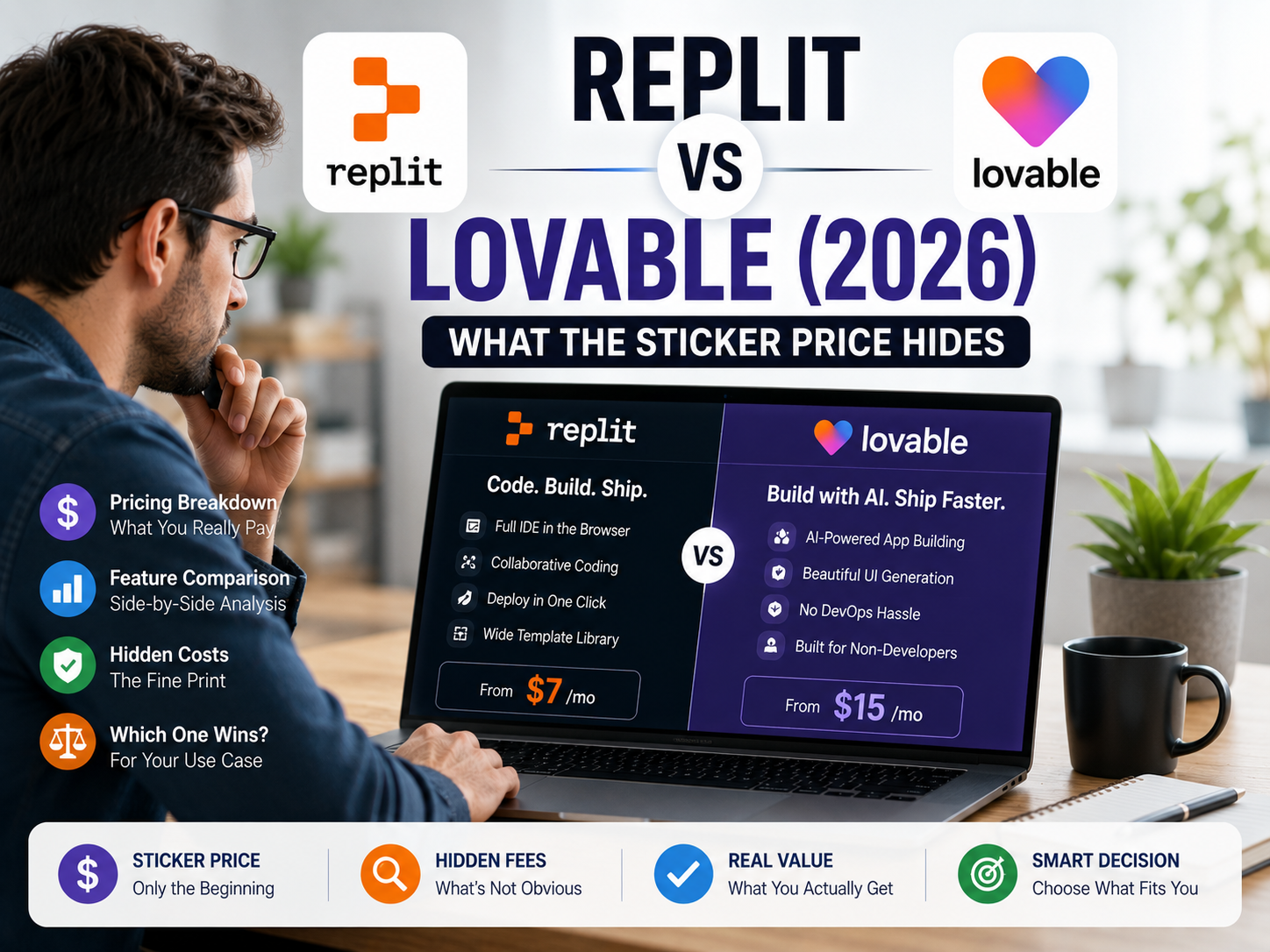
| Entry paid plan | Core — $20/month ($17/month billed annually) | Pro — $25/month |
Neither tool is trying to be the other one. Replit added AI to an already-serious coding platform. Lovable built an entire product around never needing to open a code editor in the first place. That’s the whole “lovable vs replit” debate in one sentence.
Replit vs Lovable Pricing in 2026
Replit Pricing
- Starter — Free — daily agent credits, one published app, a built-in database
- Core — $20/month ($17/month billed annually) — two parallel agents, $20 toward top-tier models, Plan Mode, unlimited workspaces, and removal of the “Made with Replit” badge
- Pro — $100/month ($95/month billed annually) — 10 parallel agents, $100 toward top-tier models, up to 15 collaborators, and database rollback up to 28 days
- Enterprise — custom pricing — SSO/SAML, single-tenant environments, and advanced privacy controls
Lovable Pricing
- Free — $0/month — 5 daily build credits (capped monthly), unlimited public projects, workspace collaboration
- Pro — reported around $25/month — private projects, custom domains, code editing, and credits that roll over
- Business — reported around $50/month — everything in Pro plus SSO and data training opt-out
- Enterprise — custom pricing — dedicated security and support for larger teams
The Credit Burn Reality: Why the Sticker Price Isn’t the Real Price
Every comparison article, including the pricing lists above, stops at the plan price. Nobody does the actual math on what a real project costs to finish — and on both platforms, that gap between sticker price and real bill is where budgets go wrong.
| Project type | Reported real-world cost |
|---|---|
| Simple one-page MVP on Lovable | Roughly 30–60 credits to ship — comfortably inside a 100-credit Pro month |
| 3-page CRUD app with auth and a database on Lovable | Routinely 150–250 credits — already over the Pro plan’s monthly allowance before revisions |
| Heavy Agent usage on Replit Core | The included $20 in monthly credits can burn through in a single day of intensive building or debugging |
Replit’s own pricing page even says so directly: Agent runs on effort-based pricing, meaning cost scales with how complex the task is, not a flat per-message rate. Deployments bill separately again — Autoscale, Reserved VM, and Scheduled deployments each draw from the same credit pool as your Agent usage.
Lovable has a similar second layer: subscription credits cover building and editing, but a deployed, live app keeps drawing on Lovable Cloud and AI usage on top of that — so a “finished” project isn’t a finished bill. This dual-layer billing pattern is common enough that it’s shown up as a named complaint in build-cost guides and on community forums for both platforms, not an isolated gripe about one tool.
The practical takeaway: budget for at least 2–3x the plan price if your project has real backend complexity, ongoing revisions, or live user traffic — on either platform. A simple landing page is the one project type where the sticker price and the real price stay close together.
The Hybrid Workflow: Build in Lovable, Ship in Replit
Here’s the part most comparisons skip, and it’s the most useful thing in this article: you don’t actually have to choose. A workflow has emerged among builders — Lovable generates the UI and initial app fast, then the project gets exported to GitHub and imported into Replit for backend logic, debugging, and production deployment.
This isn’t a workaround someone found by accident. Replit’s own comparison page includes an “Import app from Lovable” button, which means Replit officially supports and expects this exact handoff. If you want a beautiful MVP fast without giving up serious backend control, this two-tool combo is worth trying before you commit fully to either platform.
When the Hybrid Workflow Breaks Down
That workflow deserves a second look before you plan around it, because it works cleanly in a narrower set of cases than the pitch suggests. Lovable makes architecture decisions for you up front — React, Tailwind, Supabase — and the handoff to Replit goes smoothly precisely when your project stays inside those assumptions.
Step outside them and the exported code fights the tool that’s about to inherit it. Need a different database, a non-JavaScript backend, or a custom auth provider Supabase doesn’t cover well? A developer now has to read and understand an AI’s structural choices before extending them — that’s not a blank-canvas handoff, it’s inheriting someone else’s opinions about how the app should be built.
There’s a tell hiding in the community’s own phrasing: the pattern is described as using Lovable for “the first 70–80% of a project,” then finishing elsewhere. That specific fraction is itself evidence of where the friction concentrates — the last stretch, usually the part involving custom backend logic or performance work the visual builder was never designed for.
- Transfers cleanly: simple CRUD apps, dashboards, internal tools, and MVPs whose core complexity is the frontend — exactly Lovable’s home turf
- Expect friction: projects needing a non-Supabase database, unusual auth requirements, real-time systems, or heavy custom backend logic
If your project’s core value is complex backend work rather than UI, starting in Lovable can cost more time than it saves — you may end up partially rebuilding the frontend once the real backend constraints surface.
Replit vs Lovable vs Cursor: Where Does a Third Option Fit?
“Replit vs lovable vs cursor” comes up often enough to be worth a straight answer: Cursor is a code editor built for developers who already write code and want AI assistance inside their existing workflow, not a prompt-to-app builder like Lovable or a browser-based environment like Replit. If you’re a professional developer who wants AI help without leaving a familiar IDE, Cursor sits in a different lane entirely. For app generation from a plain-language prompt, the real choice stays between Replit and Lovable — and, if you’re comparing further, Bolt, which occupies similar territory to Lovable with a slightly different backend approach.
Vendor Lock-In You Don’t See Until You Try to Leave
Both companies market “no lock-in.” It’s true at the code level and misleading at the architecture level, which is the level that actually matters if you ever need to leave.
| Lock-in vector | What it actually locks in | How to reduce it |
|---|---|---|
| Lovable’s Supabase-first architecture | Code exports freely to GitHub, but auth, database, and storage are built around Supabase by default — moving off it later is a data-layer rewrite, not a code copy | Decide early whether Supabase is a genuine long-term fit, not just the fastest path to a demo |
| Replit’s built-in database, Auth, and deployments | Genuinely convenient, but they’re Replit-specific primitives — a project built entirely on them needs real re-engineering to run elsewhere | Abstract backend logic from platform-specific primitives where portability actually matters to the project |
| Billing-model familiarity | Months of usage history and cost-forecasting habits tuned to one platform’s credit or effort-based pricing don’t transfer — switching means relearning your own budget | Track real monthly cost against the sticker price from month one, so a future switch isn’t a budgeting surprise |
None of this is unique to Replit or Lovable — it’s how every AI app builder in this category works. Worth knowing before taking “no lock-in” marketing language at face value.
The Third Tool Nobody Mentions: Why Serious Builders End Up Adding Cursor Anyway
Advanced section — for readers already past the “which one do I start with” question and thinking about what happens after launch.
Replit and Lovable are both optimized for getting to a working app fast. Neither is built around the months of maintenance, debugging, and iteration that follow a real launch — that’s a different problem with different tooling economics.
Cursor charges a flat subscription with no per-message credit burn. That changes the math for heavy iteration: a developer making fifty small tweaks a day isn’t watching a credit meter the way they would be on Lovable’s per-message pricing or Replit’s effort-based billing.
The pattern that shows up repeatedly among practitioners: build the initial app and UI in Lovable or Replit, then move ongoing development into Cursor once the project graduates from “prototype” to “thing real users depend on.” It’s not a knock on either platform — they’re doing exactly what they’re built to do. It’s a reminder that “which tool should I start with” and “which tool should I still be using in six months” are often different questions with different answers.
What These Companies Are Actually Worth
Scale matters when you’re picking infrastructure for something you plan to keep building on, so here’s context most comparison articles skip entirely. Replit closed a $400 million Series D in March 2026 at a $9 billion valuation, up from $3 billion just six months earlier, and has stated it’s targeting $1 billion in annual recurring revenue by the end of 2026.
Lovable has grown even faster on the funding side. The company raised $400 million at a $13.3 billion valuation in August 2026, according to Bloomberg, with backers including Menlo Ventures and Tencent — more than double its $6.6 billion valuation from December 2025. Lovable’s reported annual recurring revenue sits around $500 million as of mid-2026, on roughly 8 million users.
Neither number tells you which tool to pick for your project. Both tell you these aren’t scrappy side projects likely to disappear next year — they’re two of the best-funded companies in AI coding, competing hard enough that both are shipping new features monthly.
Which One Should You Actually Use?
- Non-technical founders and designers: Lovable, for speed and design polish without touching code
- Developers building production apps: Replit, for full code control and debugging depth
- Fast MVP with a real backend later: Lovable first, then export to Replit — the hybrid workflow above
- Teams needing enterprise security controls: either works, but check SSO and compliance features on both before committing
- Students and hobbyists learning to code: Replit, since you actually see and interact with the code
Myth vs Reality: What Most Comparison Articles Get Wrong
| Myth | Reality |
|---|---|
| “No lock-in” means you can leave anytime, painlessly | Code exports freely, but the architecture underneath (Supabase, Replit’s built-in primitives) is the real dependency |
| Replit’s $20 Core plan means a predictable $20 bill | Effort-based pricing means heavy Agent usage or deployments can burn past the included credits fast — Replit’s own FAQ addresses this directly because it’s common |
| You have to pick one tool and commit | The Lovable-to-Replit import button exists because plenty of builders use both, at different stages of the same project |
| “Non-technical” means you’ll never need to touch code | Lovable ships an optional code editor and Dev Mode specifically because non-technical users hit walls the AI alone can’t clear |
| More included credits automatically means better value | What a credit actually costs to spend varies by task complexity, so raw credit counts across plans aren’t directly comparable |
| Replit’s cheaper entry price ($20 vs. Lovable’s $25) makes it the cheaper platform overall | Real-world cost reports for both platforms describe final bills running 2–3x the sticker price once usage scales — entry price is a weak predictor of total cost |
Frequently Asked Questions
Is Replit better than Lovable?
It depends on what you’re building. Replit is generally considered better for developers who want code control and debugging depth. Lovable is generally considered better for non-technical users who want a fast, polished app without touching code.
Can I move a Lovable project into Replit?
Yes. Lovable projects can be exported to GitHub and then imported into Replit — Replit’s own comparison page includes a dedicated “Import app from Lovable” option, confirming this is an officially supported workflow.
Which is cheaper, Replit or Lovable?
Replit’s entry paid plan (Core) runs $20/month, or $17/month billed annually. Lovable’s entry paid plan (Pro) is reported at around $25/month. Actual cost depends heavily on usage in both cases, since both platforms bill extra credits or compute on top of the base subscription.
Is Lovable good for complete beginners?
Yes — that’s specifically who Lovable is built for. Its chat-first interface requires no coding knowledge, though very complex backend logic may eventually require exporting to a tool like Replit or Cursor.
If you’re weighing AI tools for a broader build — not just the coding layer — our Claude AI walkthrough covers the model that powers a lot of AI coding assistance under the hood. You can also browse every comparison we’ve published in AI Tool Comparisons.