Ai tools for affiliate marketing

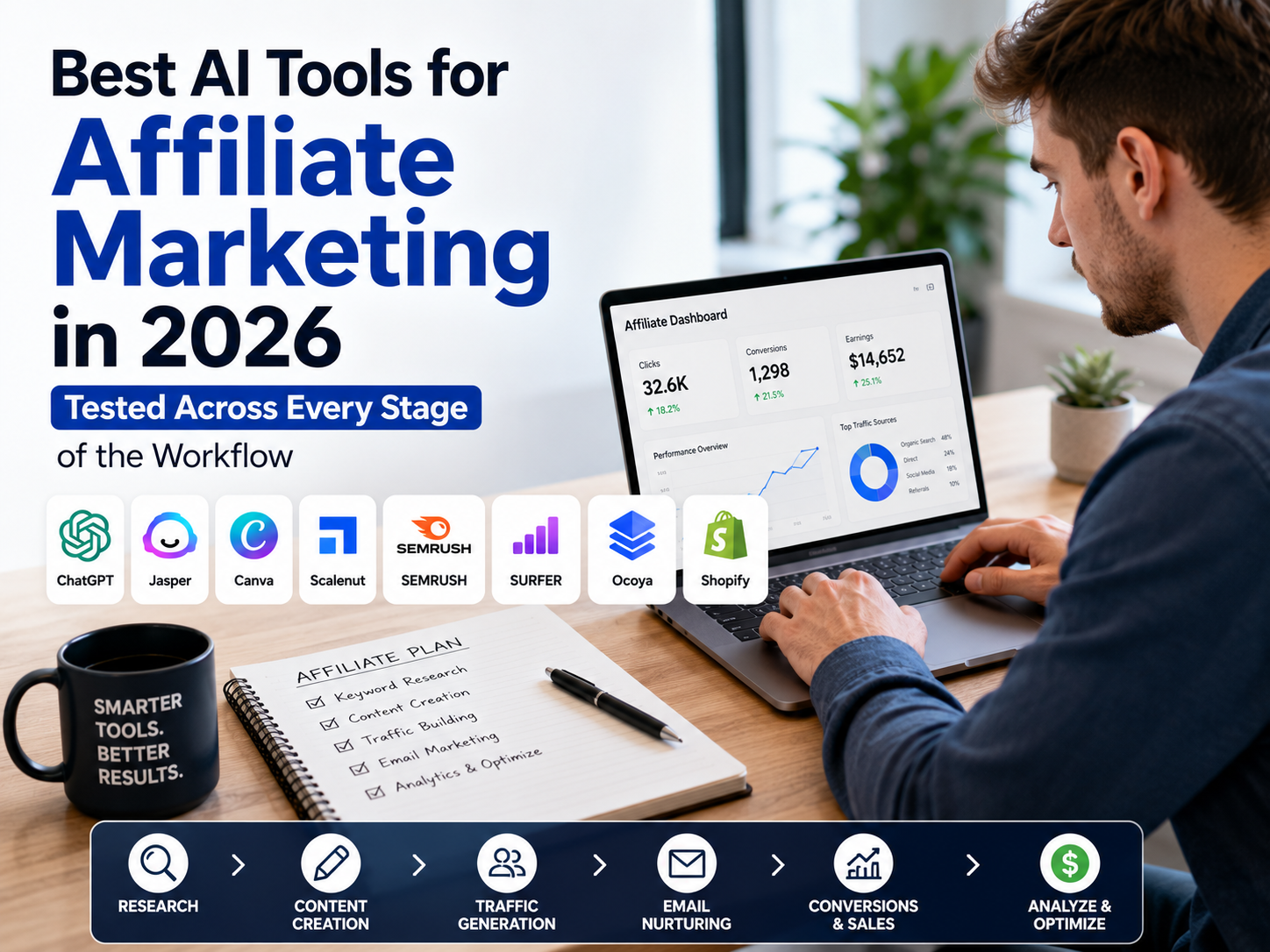
Best AI Tools for Affiliate Marketing in 2026 — Tested Across Every Stage of the Workflow

By Shivam  |  Updated: August 2026  |  14 min read  |  Tested Tools Pricing Re-Verified August 2026 Free Options Included

Shivam — CrixPix founder
Written by Shivam
Software engineer & Founder of CrixPix · Runs affiliate content sites alongside reviewing AI tools
✓ Tools used in active affiliate workflows · Pricing re-checked August 2026

The best AI tools for affiliate marketing aren’t the ones with the most features — they’re the ones that remove the bottlenecks that actually slow affiliate income down. For most affiliate marketers in 2026, those bottlenecks are content production speed, keyword competition analysis, and converting email subscribers. This guide covers the tools that solve each one, organized by the affiliate workflow stage they address, with honest assessments of free options at every stage.

⚡ Quick Answer — Best AI Tools for Affiliate Marketing by Category (2026):

🖊️ Content writing: Claude (best output quality), Jasper AI (best for teams)
🔍 SEO & keyword research: Semrush (best research), Surfer SEO (best optimization)
📧 Email marketing: GetResponse AI, ActiveCampaign
🎬 Video content: InVideo AI (free plan available), CapCut
🎨 Images & thumbnails: Canva AI (free plan), Midjourney (premium)
💰 Free starter stack: Claude free + Canva Free + Google Keyword Planner = $0/month

Full breakdown with pricing, workflow integration, and honest pros/cons below.
10
Tools used in live affiliate workflows
6
Workflow stages covered
$0
Minimum cost with free stack
Aug 2026
Pricing re-checked

What “AI Tools for Affiliate Marketing” Actually Means in 2026

When you search “AI tools for affiliate marketing,” you’ll find two very different types of results mixed together — and knowing which category you need saves you from buying the wrong thing.

Category A: AI tools that have affiliate programs. These are tools you can promote and earn a commission for recommending — Jasper, Semrush, GetResponse, and similar. Sites like PartnerStack list dozens of these. They’re relevant if you want to sell AI tools as your affiliate niche.

Category B: AI tools you use to run your affiliate business. These are tools that help you write content faster, rank higher on Google, build email lists, and create promotional videos. They are instruments, not the products you promote.

This guide covers Category B — the tools that actually move your affiliate income up. Most of the highly-ranked articles on this topic mix the two categories into one confusing list. We don’t.

📌 One note on AI affiliate programs: Many of the tools in Category B also have their own affiliate programs. Semrush pays a flat $200 for a new subscription (with higher tiered bonuses for top-volume affiliates), and GetResponse and Jasper both pay recurring commissions with specific caps and time limits detailed in each section below. If you build an audience in the AI niche while using these tools, promoting them alongside honest reviews is a legitimate dual-use strategy — just don’t let the commission structure quietly become the reason a tool gets ranked higher than it deserves.

Quick Comparison: AI Tools for Affiliate Marketing by Workflow Stage

Workflow StageBest Paid ToolBest Free OptionWhat It Solves
Content WritingJasper AI / Claude ProClaude (free tier)Slow content production, writer’s block, inconsistent quality
Keyword ResearchSemrushGoogle Keyword PlannerNot knowing which keywords you can actually rank for
On-Page SEOSurfer SEONeuronWriter (free trial)Publishing content that doesn’t rank despite good writing
Email MarketingGetResponse AI / ActiveCampaignGetResponse free (500 contacts)Low email open rates, manual sequence building
Video ContentInVideo AICapCut (free)No YouTube presence alongside blog, slow video production
Images & CreativeMidjourneyCanva AI (free plan)Generic stock photos, low-CTR thumbnails, no visual identity

Category 1 — AI Content Writing Tools

Content is the core of almost every affiliate strategy — product reviews, comparison articles, buyer’s guides, and listicles. The right AI writing tool doesn’t replace your expertise; it removes the production lag between having an idea and having a published, optimized article.

Best for Quality

1. Claude — Best AI for Long-Form Affiliate Content

Free Tier Pro $20/mo Best Output Quality Content Writing

Claude consistently produces the best long-form affiliate content of any AI writer we’ve used. The key reason is instruction-following precision — when you tell it to write a 2,500-word comparison article structured as [intro, overview table, 5 tool sections with pros/cons, FAQ, conclusion], it does exactly that, maintaining coherent argument and consistent tone from start to finish without drifting.

For affiliate marketing specifically, Claude handles the two hardest content types particularly well: nuanced product comparisons (where it can hold multiple product specs in context simultaneously and compare them logically) and buyer’s guides (where it structures decision criteria in a way readers actually find useful, rather than padding to hit word count). The free tier handles long documents in context — enough for full-site content planning in a single session.

One real limitation: Claude doesn’t browse the web or pull live pricing data by default unless you’re using a version with that capability enabled. For affiliate content that requires current pricing, verify the data yourself against the vendor’s own page — as this article’s own pricing corrections below illustrate, several tools have restructured plans more than once in 2026, and any AI writer’s training data can lag behind that.

✅ Pros

  • Best instruction-following of any AI writer
  • Excellent long-form structure — naturally creates scannable content
  • Large context window handles full projects in one session
  • Free tier is genuinely functional for regular content production
  • Rarely hallucinates facts when given accurate source material

❌ Cons

  • No default web browsing — you supply or verify the facts
  • Free tier has usage limits during peak hours
  • No built-in SEO optimization (pair with Surfer SEO)
Best for: Writing full-length product reviews, comparison articles, and buyer’s guides. The go-to content engine for solo affiliate marketers who need quality without a team.
Best for Teams

2. Jasper AI — Best for Affiliate Teams with Brand Voice

Pro from $69/mo ($59/mo annual) Best for Teams Content Writing

Jasper AI earns its place for affiliate marketing operations that have grown beyond a single site or writer. Where Claude excels at raw output quality, Jasper’s advantage is brand voice consistency at scale — you train it on your site’s tone, vocabulary, and style, and it applies that voice across every piece of content produced by every team member.

Jasper restructured its pricing in 2026: the current live plan is Pro at $69/month ($59/month billed annually), covering a single seat with a couple of Brand Voices and Knowledge assets. Beyond that, Business is custom-priced (contact sales) for teams needing unlimited seats, unlimited Brand Voices, and admin controls — there’s no longer a flat, published “Teams” tier at a fixed price. Some third-party trackers still list an older, cheaper “Creator” plan around $49/month, but it doesn’t appear on Jasper’s own live pricing page as of this update — treat that figure as unconfirmed and check jasper.ai directly before budgeting.

For multi-site affiliate operators or agencies running campaigns for multiple clients, Jasper’s Canvas platform and Knowledge Base still make it faster to maintain distinct voices across properties, and its templates for things like “affiliate product review” reduce brief-writing overhead compared to more general AI tools.

✅ Pros

  • Brand voice training — consistent tone across all content
  • Marketing-specific templates and content pipelines
  • Team collaboration tools on Business tier
  • Integrates with Surfer SEO for in-workflow optimization

❌ Cons

  • $69/month minimum for a single seat — not justified for a single blog
  • Business pricing isn’t published — budgeting requires a sales call
  • No free plan — 7-day trial only
Best for: Affiliate marketing operations with multiple writers or multiple sites that need consistent brand voice without manual editorial oversight on every piece.

Category 2 — AI SEO & Keyword Research Tools

The most common reason affiliate sites fail isn’t bad content — it’s targeting keywords they can’t realistically rank for, or optimizing content based on guesswork instead of what the current top-10 results actually contain. AI-powered SEO tools solve both problems.

Best for Research

3. Semrush — Best for Keyword Research & Competitor Analysis

Limited Free Searches/Day Pro $139.95/mo SEO Research

Semrush is the industry standard for affiliate keyword research because it gives you the two numbers that actually matter: search volume (how many people search this term) and keyword difficulty (how hard it is to rank for, on a scale of 0–100). The combination tells you which keywords are worth targeting given your site’s current authority.

For affiliate marketing, the critical Semrush use case is finding low-KD commercial-intent keywords — search terms where the person is ready to buy something but where your site can realistically appear in the top 10. Keywords with KD under 30 and CPC above $3 are typically the highest-value targets for a growing affiliate site: the search represents commercial intent (high CPC), and the ranking competition is manageable (low KD).

Semrush’s free access gives a small number of keyword and domain lookups per day — enough to evaluate the viability of a new affiliate niche or spot-check target keywords before committing to an article, though not enough for a full research session. Paid plans start at $139.95/month (Pro), which is significant but is returned quickly on a profitable affiliate site. Semrush’s affiliate program pays a flat $200 for each new subscription referred, with higher tiered bonuses (reportedly $300–450 per sale) available to top-performing affiliates — a claim of “10% on renewals” sometimes repeated elsewhere isn’t confirmed in Semrush’s current published program terms, so don’t count on it when modeling expected income.

✅ Pros

  • Most accurate keyword difficulty scores available
  • Competitor content gap analysis — find keywords competitors rank for that you don’t
  • Position tracking — monitor your affiliate articles daily
  • Free tier covers basic keyword validation
  • Affiliate program pays a flat $200/referral, more for top performers

❌ Cons

  • $139.95/month is a significant cost for new affiliates
  • Feature depth can be overwhelming initially
  • Some keyword volume figures lag behind real-time data
Best for: Serious affiliate marketers who need to know exactly which keywords to target and exactly how hard the competition is before investing writing time.
Best for Optimization

4. Surfer SEO — Best for On-Page Affiliate Content Optimization

Entry plan ~$89–119/mo (varies by source/date) On-Page SEO

Surfer SEO solves the specific problem of publishing well-written affiliate content that doesn’t rank. It analyzes the top-ranking pages for your target keyword and tells you — in real time as you write — the word count range, heading structure, term frequency, and NLP entities that the top 10 results share. You’re not guessing what Google wants to see; Surfer shows you the pattern.

⚠️ A genuine warning on Surfer’s pricing: Surfer has renamed and repriced its plans multiple times in the past year, and even sources dated within the past few weeks of each other disagree on the current entry-tier name and price — cited figures for the base plan range from roughly $89 to $119/month depending on when and where you look, and some trackers report an entirely different tier structure (e.g., “Discovery/Standard/Pro” rather than “Essential/Scale”). Don’t trust any third-party number, including ours — check surferseo.com directly before budgeting.

The Content Editor is the core workflow feature regardless of what the current plan is called: paste or write your article in the editor, and Surfer scores it as you add terms and structure, with a practical target score benchmark for competitive content. The tool integrates directly with Google Docs and WordPress, so your editorial workflow doesn’t change — Surfer sits alongside it.

For affiliate sites in competitive niches — personal finance, health, software — Surfer SEO frequently makes the difference between a page ranking on page 2 (no traffic) and page 1 (meaningful traffic). In lower-competition niches (KD under 30), it’s less critical but still useful for initial content structure.

✅ Pros

  • Real-time content scoring as you write
  • Shows exactly what top-10 pages contain that yours doesn’t
  • Google Docs and WordPress integration
  • Audit tool for improving existing affiliate articles
  • Pairs naturally with Claude or Jasper in the same workflow

❌ Cons

  • Pricing and plan names have changed repeatedly in 2026 — confusing to budget around
  • Over-optimizing to the score can make content feel mechanical
  • No free plan — trial only, and add-ons (SERP Analyzer, Rank Tracker, AI Tracker) stack quickly on top of the base price
Best for: Affiliate marketers targeting competitive keywords (KD 40+) where content quality alone isn’t enough to rank. Pair with Semrush for research and Claude for writing.

Category 3 — AI Email Marketing Tools

Email is widely cited as one of the higher-converting affiliate channels, though the specific “$X return per $1 spent” figures that circulate in marketing content vary a lot by source and are worth treating skeptically rather than repeating as a fixed number. The AI layer in modern email tools automates the two most time-consuming parts: writing sequences and optimizing send times. Here are the two tools that do it best for affiliate use cases.

Best Free Tier

5. GetResponse AI — Best Email Tool for Affiliate Marketers

Free to 500 Contacts Paid plans from ~$15/mo (check current tier names) Email Marketing

GetResponse has one of the better combinations of affiliate-friendly features and a usable free plan among email platforms in 2026. The free plan covers up to 500 contacts and includes unlimited email sends, making it genuinely functional for a new affiliate site building its first list. The AI email generator writes subject lines and email body copy from a brief — useful for testing variants without writing every message manually.

The most valuable affiliate-specific feature is the conversion funnel builder, which connects your opt-in form, welcome sequence, and affiliate offer emails into a single managed workflow. Many affiliate marketers use GetResponse specifically because it handles the full path from traffic → subscriber → conversion without requiring separate tools for each stage. Note that some affiliate networks restrict the use of their links in email campaigns — always check your network’s terms before sending affiliate links directly in email.

GetResponse’s affiliate program has historically paid recurring commissions (commonly cited around 33%) — confirm the current rate and terms on GetResponse’s own affiliate page before modeling expected income, since email marketing platforms revise affiliate terms periodically like everyone else in this list.

✅ Pros

  • Free plan covers up to 500 contacts — real usability, not just a trial
  • AI-generated subject lines and email copy
  • Conversion funnel builder connects opt-in → sequence → offer
  • Affiliate-friendly terms (unlike some platforms that ban affiliate links)

❌ Cons

  • AI copy quality requires editing before sending
  • Advanced automation features require paid plans
  • UI feels older compared to newer email platforms
Best for: Affiliate marketers building their first email list who want a free start with genuine capacity, plus AI assistance for email copy.

Category 4 — AI Video Creation Tools

YouTube is a major traffic source in its own right, and affiliate marketers who build video channels alongside their blogs often see additional commissions from the combined traffic. AI video tools in 2026 have made producing a YouTube affiliate review significantly faster than recording, editing, and narrating traditional screen capture content.

Best for YouTube

6. InVideo AI — Best for YouTube Affiliate Content

Free Plan (Watermarked) Plus $25/mo Video Creation

InVideo AI turns a text script into a complete YouTube-ready video — with voiceover, B-roll footage, text overlays, and transitions — in under 10 minutes. For affiliate marketers who want a YouTube presence without learning video editing, this is a practical entry point. The AI handles the production mechanics; you supply the script and affiliate angle.

The free plan includes unlimited video creation but adds a watermark. The Plus plan at $25/month removes the watermark and is the appropriate starting point for any affiliate channel intending to monetize.

✅ Pros

  • Script-to-video in under 10 minutes
  • Large stock media library for B-roll
  • Free plan for testing output quality
  • Good for product review format videos

❌ Cons

  • Free plan watermark prevents monetization
  • AI voiceover quality varies by language
  • Less control over visuals than manual editing
Best for: Affiliate marketers adding a YouTube channel to their strategy who want to produce regular review videos without learning video editing. See our guide on the best AI tools for YouTube thumbnails to pair with InVideo for channel growth.

Category 5 — AI Image & Creative Tools

Featured images, comparison graphics, and social media visuals affect affiliate site performance in two specific ways: they determine whether readers engage with your content (bounce rate) and whether they click your social media posts in the first place (CTR). Generic stock photos do neither job well. AI-generated images that are specific to your content do both.

Best Free Option

7. Canva AI — Best Free Image Tool for Affiliate Marketers

Generous Free Plan Pro $15/mo Image Creation

Canva AI is the most practical image tool for affiliate content because it handles both generation and layout in the same app. You generate a featured image for your review article, a comparison graphic for your comparison post, and a YouTube thumbnail for your video — and export all three in the correct dimensions, without switching between apps or learning design software.

The free plan includes a monthly allowance of AI image generations (Canva has adjusted this limit before, so check your account’s current count) plus a large template library, which covers a solid publishing cadence for most affiliate sites. The full comparison of Canva’s AI tools versus Adobe Firefly’s image quality is covered in our Canva AI vs Adobe Firefly comparison. For affiliate sites specifically, Canva’s workflow advantage outweighs Adobe Firefly’s quality advantage for most use cases — unless you’re in a niche where premium product imagery is critical.

✅ Pros

  • Generate and design in one tool — no export/import
  • Free plan includes a workable monthly AI image allowance
  • YouTube thumbnail, blog image, and social templates pre-sized
  • Magic Write for accompanying text

❌ Cons

  • AI image quality below Midjourney for creative visuals
  • Free tier has a shared monthly AI credit pool — heavy use drains it fast
Best for: Most affiliate marketers who need featured images, thumbnails, and social graphics at no cost and with no design learning curve.

8. Midjourney — Best for Premium Affiliate Visuals

From ~$10/mo (check current tier) Premium Images

Midjourney produces higher-quality, more visually distinctive images than Canva AI — particularly for lifestyle, tech, and finance niches where visual quality contributes to brand perception. The typical workflow is: generate a custom hero image in Midjourney, import it into Canva, add text overlay and branding. The combination produces featured images that look professionally photographed rather than stock or AI-generic.

For affiliate sites that are already earning, Midjourney’s entry-level plan is a reasonable add. For sites still building toward their first income, the Canva free tier covers the need adequately. Full breakdown in our Midjourney vs Leonardo AI comparison.

Best for: Established affiliate sites where visual differentiation contributes to brand trust and time-on-page in premium niches.

The Best Free AI Tools for Affiliate Marketing — $0/Month Stack

You don’t need a large monthly tool budget to build a functional affiliate site in 2026. Here is a complete free stack that covers every stage of the workflow:

✅ Complete Free AI Affiliate Marketing Stack

  1. Content writing: Claude free tier — long-form reviews, comparison articles, buyer’s guides. The free version handles full-length articles without quality degradation.
  2. Keyword research: Google Keyword Planner (free with Google account) + Semrush’s limited free daily searches — covers keyword validation and basic competitive assessment.
  3. On-page SEO: Rank Math free plugin (WordPress) + Google Search Console — tracks rankings and flags on-page issues at zero cost.
  4. Images: Canva free plan — monthly AI-generated image allowance, large template library, YouTube thumbnail export at correct dimensions.
  5. Email: GetResponse free plan — up to 500 contacts, unlimited sends, basic automation.
  6. Video: CapCut free — edit and produce YouTube shorts or product clips. InVideo AI free for script-to-video (watermarked — upgrade when ready to monetize).
  7. Analytics: Google Analytics 4 + Google Search Console — both free, both essential.

This stack covers content production, SEO research, image creation, email marketing, and analytics at $0/month. The main capability gap versus paid tools is advanced on-page optimization (Surfer SEO) and deep competitor research (Semrush Pro, $139.95/month) — both can be added when your affiliate income justifies the investment.

The AI Affiliate Marketing Workflow — How These Tools Work Together

The tools above only produce results when they connect into a workflow. Here is the practical sequence that active affiliate marketers use in 2026 to go from keyword to published content to email promotion:

1

Find a rankable keyword (Semrush)

Search your niche in Semrush. Filter for keywords with KD under 35 and commercial intent (words like “best,” “review,” “vs,” “alternative”). Note the CPC — higher CPC signals advertisers are willing to pay for this audience, meaning affiliate offers in this space probably convert.

2

Research what Google wants to rank (Surfer SEO or manual SERP review)

Open the top 5 ranking pages for your keyword. Note word count range, heading structure, and what specific questions they answer. If using Surfer SEO, create a Content Editor document for your keyword and let it pull this data automatically.

3

Write the article (Claude)

Give Claude your keyword, your target word count, the heading structure you want, the products to cover, and any verified facts (pricing, specs, features) you’ve collected. Specify that it should not invent data and should flag where you need to fill in specifics. Edit the output — Claude drafts, you finalize. Never publish raw AI content without a human review pass.

4

Optimize the article (Surfer SEO + Rank Math)

If using Surfer, score the article and add missing terms until you hit the tool’s target benchmark. In Rank Math, confirm your primary keyword is in the title, first paragraph, one H2, and meta description. Check that your internal links are in place — link to at least two other articles on your site.

5

Create visuals (Canva AI)

Generate a featured image that’s specific to the article topic — not a generic stock photo. If you have a YouTube channel, generate the thumbnail here too. The thumbnail for an affiliate product review should show the product, a strong emotion or reaction, and a text hook of under 5 words.

6

Publish and promote to email list (GetResponse)

Send a broadcast email to your list announcing the new article — not the affiliate link directly, but the content. Let the content earn the click. Write subject lines using A/B variants; GetResponse’s AI can generate several subject line options from a brief, which is faster than writing them manually.

💡 The one workflow rule that prevents most AI affiliate content failures: AI writes the draft; you add the experience. Every review article needs at least one section — even a paragraph — where you describe using the product, testing it, or comparing it to something you actually used. Google’s helpful content guidelines specifically look for first-person experience signals. A 100% AI-written review with no experiential detail is the pattern their systems are trained to identify.

5 Mistakes Affiliate Marketers Make With AI Tools

❌ Mistake 1: Publishing AI content without fact-checking

AI writing tools hallucinate. They will confidently state incorrect pricing, wrong feature names, and outdated plan details — this article’s own pricing corrections above are a live example of how fast that data goes stale. Every factual claim in your affiliate content — pricing, specs, availability, terms — must be verified against the source before you publish. A product review with wrong pricing gets flagged by readers in the comments and tanks trust.

❌ Mistake 2: Targeting keywords they cannot rank for

The most common affiliate SEO mistake is targeting keywords with KD above 70 with a site that has a domain rating below 20. No amount of AI-generated content closes that gap. Use Semrush to filter for keywords with KD under 35 first. The traffic from ranking on page 1 for a KD 20 keyword is real money. The traffic from ranking page 7 for a KD 80 keyword is zero.

❌ Mistake 3: Using AI to write fake or implied product experience

This violates FTC disclosure requirements, most affiliate network terms, and Google’s helpful content guidelines simultaneously. Do not instruct AI to write “I tested this product” if you haven’t. The correct approach: write what you know from verified sources and clearly label first-person experience sections as your own observation.

❌ Mistake 4: Using AI tools as a replacement for a content strategy

AI dramatically accelerates content production. It does not replace the judgment of what to write and why. Affiliates who use Claude to produce dozens of articles a month on random topics with no keyword strategy end up with content that collectively earns little. The keyword research step is where affiliate income is made or lost — AI tools execute your strategy, they don’t replace it.

❌ Mistake 5: Over-automating email sequences

AI email tools make it easy to build long affiliate sequences in an afternoon. The problem: long, heavily automated sequences that push affiliate offers every other email destroy list trust quickly. Most successful affiliate email strategies send fewer emails, with more value-first content, and reserve direct offer emails for audiences that have already demonstrated intent. Less automation, more trust, better conversions.

Expert Tips: Getting Real Results from AI in Affiliate Marketing

  1. Use AI to find the angle, not just the words. Give Claude five competing articles on your target topic and ask it which angle is underserved or where the existing content is misleading or incomplete. This produces better first-draft briefs than any prompt template.
  2. Build a prompt library for your niche. Your best Claude prompts for product reviews, comparison intros, and FAQ sections are repeatable assets. Save them in a document. A prompt that produces a good product review structure today will work months from now. Rebuilding it from scratch each time is wasted effort.
  3. Use Semrush to find affiliate niches, not just keywords. Look at what keywords your established competitors rank for that you don’t yet cover. Every gap in their content map is an opportunity for you — and because they’ve already validated that people search for this content, the market research is done.
  4. Test email subject lines with AI before sending. Generate several subject line variants for every email campaign and send them to a small segment first. A meaningful improvement in open rate on a list of a few thousand people means hundreds more people reading your affiliate content per send — that compounds over a year.
  5. Add a human “Experience Note” to every AI product review. Write a short sidebar in your own words about your actual experience — with the tool, the category, or the problem the product solves. This satisfies Google’s E-E-A-T requirement, differentiates your content from pure AI output, and builds reader trust in a way that no prompt can replicate.

What Experienced Affiliate Marketers Tend to Emphasize

🗂️ Recurring themes across affiliate marketing guides and case studies, not a specific forum poll

  • Content plus research tooling, not content alone: the affiliate sites that report consistent income tend to pair an AI writer (Claude, Jasper) with a dedicated keyword research tool (Semrush or similar) rather than relying on either alone.
  • “Google can tell” is the most common complaint about AI content: the pattern that draws scrutiny is perfectly structured content with no concrete examples, no linked pricing sources, and no first-person voice anywhere in the article — regardless of which specific AI tool produced it.
  • The hybrid workflow is widely recommended over either extreme: using AI for a first draft, then spending real time personalizing it with your own experience, current pricing, and at least one original example, is a commonly cited approach that outperforms both fully-automated and fully-manual content.
  • Research tooling gets more credit for income than writing tooling: a recurring theme among people who write about their own affiliate income is that finding low-competition, high-commercial-intent keywords mattered more to their results than which AI writer they used.

Frequently Asked Questions

What are the best AI tools for affiliate marketing in 2026?

The best AI tools for affiliate marketing organized by what they do: Claude and Jasper AI for content writing, Semrush and Surfer SEO for keyword research and on-page optimization, GetResponse AI and ActiveCampaign for email marketing, InVideo AI and CapCut for video content, and Canva AI and Midjourney for images and thumbnails. The most important single tool is Semrush — knowing which keywords to target determines whether any of the others are used on content that actually earns traffic.

Can you do affiliate marketing with AI tools for free?

Yes. A fully functional affiliate workflow is possible at zero cost using: Claude free tier for content writing, Google Keyword Planner for keyword research, Semrush’s limited free daily searches for keyword verification, Canva Free for images, GetResponse free plan for email up to 500 contacts, and CapCut or InVideo AI free for video. The areas where paid tools create the biggest practical gap are advanced on-page SEO (Surfer SEO) and deep competitor analysis (Semrush Pro). Both can wait until your affiliate income justifies the spend.

Is using AI for affiliate marketing allowed?

Yes, with important limits. AI-assisted affiliate content is permitted by Google, most affiliate networks, and content platforms as of 2026. The rules: AI content must be factually accurate (verify all pricing, specs, and claims), reviews must reflect genuine product evaluation rather than fabricated experience, and all content must meet Google’s helpful content guidelines — which require demonstrating real expertise, not just well-structured information. Using AI to mass-produce thin content or fake reviews violates both Google guidelines and most affiliate network terms.

What is the best AI tool for writing affiliate product reviews?

Claude is the best AI tool for writing affiliate product reviews. It follows structural instructions precisely, maintains consistent argument and tone across long documents, handles complex product comparisons coherently, and produces content that reads at a natural human register rather than obviously AI-generated. Always review and personalize Claude’s output before publishing — add your own experience notes, verify all pricing, and confirm the article addresses the specific questions real buyers ask about the product.

How do AI tools help with affiliate marketing SEO?

AI tools improve affiliate SEO in three specific ways. Keyword research tools (Semrush) use AI to calculate ranking difficulty and identify which keywords you can realistically rank for at your site’s current authority. On-page optimization tools (Surfer SEO) analyze the top-ranking pages for your target keyword and tell you what your content needs to include to compete. Content tools (Claude, Jasper) produce full drafts from your brief faster than manual writing, allowing you to publish consistently — which compounds your ranking signal over time. Together they address the three main SEO failures on affiliate sites: targeting impossible keywords, writing unoptimized content, and publishing too infrequently to build momentum.

Which AI tools do successful affiliate marketers actually use?

The most consistent AI stack among profitable affiliate marketers tends to be: Claude or Jasper for content, Semrush for keyword research and competitive analysis, Surfer SEO for on-page optimization, Canva AI for images and thumbnails, and GetResponse or ActiveCampaign for email. Many higher-volume affiliates have added InVideo AI to build YouTube channels alongside their blogs. The pattern among high earners is fewer tools used deeply, rather than many tools used superficially.

Bottom Line — Which AI Tools Should You Actually Start With?

✅ The Honest Recommendation

If you are just starting an affiliate site: begin with Claude free for content and Semrush’s free daily searches for keyword research. These two tools together — at zero cost — cover the most important decisions you need to make: what to write and how to write it well. Add Canva Free for images and GetResponse free for email, and you have a complete affiliate operation at $0/month.

When your site is earning, upgrade in this order: Semrush Pro first (keyword research determines everything), then Surfer SEO (on-page optimization moves your existing articles up — check its current live pricing, since it’s changed repeatedly this year), then Jasper Pro or Claude Pro (faster content production). Skipping directly to premium tools before your keyword strategy is solid is where most affiliate marketing budgets go to waste.

The full “make money with AI” picture — including AI automation agencies, AI dropshipping, and passive income methods — is covered in depth in our complete guide to making money with AI in 2026.

🚀 Ready to Build Your AI Affiliate Stack?

Start free today: Claude.ai for content writing · Semrush for keywords · Canva for images
Want more AI income strategies? Read our full make money with AI guide →

Bookmark CrixPix.com for AI tool guides built for real creators, re-checked as pricing changes.

Similar Posts

Leave a Reply

Your email address will not be published. Required fields are marked *