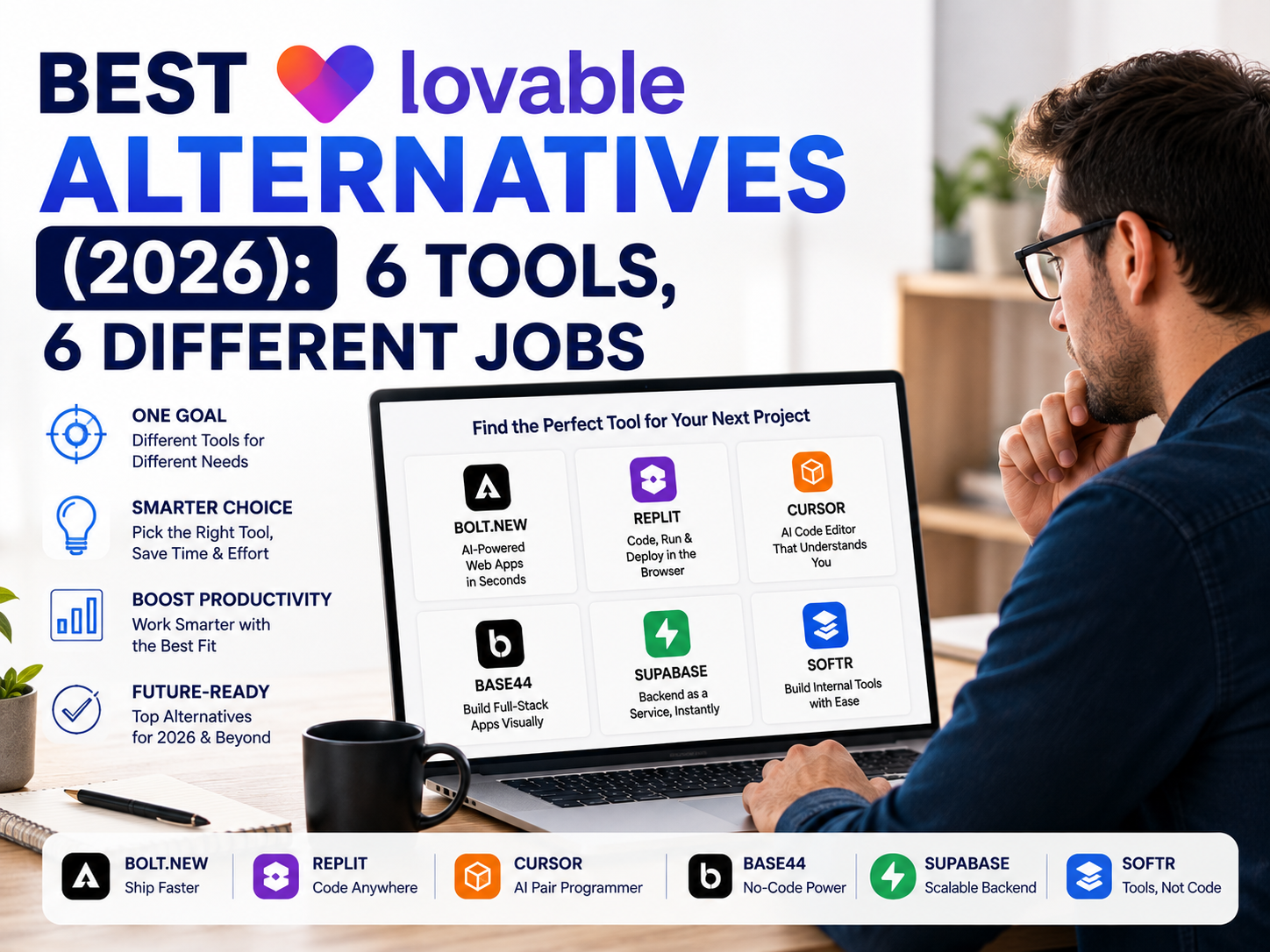
Best Lovable Alternatives in 2026: 6 Tools, 6 Different Jobs
Lovable is genuinely good at what it does: turn a paragraph of plain English into a working, good-looking app. But “genuinely good at one thing” is exactly why people go looking for a Lovable alternative. Maybe you’ve hit a wall on complex backend logic. Maybe the credit bill surprised you. Maybe you just want to see the code.
Most lists of lovable.dev alternatives solve this by throwing ten or twelve tools at you and letting you sort it out. That’s not actually helpful — half of those tools are chasing the same use case with a different logo. Below are six alternatives that each do a genuinely different job, so the real work here is matching the tool to what you’re actually building, not just picking the top result.
How this comparison was put together: pricing for each tool was checked against its own official pricing page where the page rendered in plain text, and cross-verified against multiple independent 2026 trackers where it didn’t. Company facts (funding, acquisitions, user counts) come from primary sources — company blogs, Bloomberg, and verified press coverage. Details current as of September 2026 — always confirm live pricing before you subscribe.
Quick Comparison: Lovable Alternatives at a Glance
| Tool | Best for | Starting paid price |
|---|---|---|
| Replit | Full code control and debugging | $20/month |
| Bolt.new | Raw build speed, in-browser | ~$25/month (reported) |
| v0 by Vercel | Polished React/Next.js UI | $30/month |
| Base44 | All-in-one, true no-code | $16–20/month |
| Bubble | Complex business logic, no code at all | ~$29/month |
| Cursor | Developers who already write code | $20/month |
Why “Free Tier” Comparisons Are Nearly Useless Here
Every alternatives list runs some version of a checkbox row: Free tier — yes, yes, yes, yes, yes, yes. That row is technically accurate and practically meaningless, because these six tools don’t meter usage the same way at all.
| Tool | What the free tier actually meters |
|---|---|
| Replit | Daily agent credits that reset — a burst-friendly model |
| Bolt.new | 1 million tokens/month, scaling with project complexity, not message count |
| v0 | $5 in monthly dollar-credits, with a reported 7-message-per-day cap |
| Base44 | Two separate pools — message credits for building, integration credits for live features |
| Bubble | 50,000 Workload Units — a server-computation metric with no AI generation involved at all |
| Cursor | Limited completions and slow requests, gated by which model you select |
Five different governance models hiding behind one word. A free tier that gives you a burst of daily credits behaves nothing like one that gives you a fixed monthly dollar balance capped at seven messages a day — and neither behaves anything like Bubble’s Workload Units, which aren’t measuring AI generation at all, just server-side computation.
The better test isn’t “does it have a free tier.” It’s “can I ship one real, working feature — not a demo, an actual feature with a database read and a user action — entirely inside the free tier.” That question filters out most of the false equivalence a checkbox table creates.
6 Best Lovable Alternatives, Compared in Detail
1. Replit — Best for Full Code Control
If Lovable’s biggest limitation for you is “I can’t actually get into the code,” Replit is the direct answer. It’s a browser-based development platform with an AI layer, Agent, that scaffolds servers, wires up databases, and debugs its own mistakes — but you always see the terminal, the file tree, and the database underneath.
Replit’s Core plan runs $20/month ($17/month billed annually), and its own comparison page even includes a dedicated “Import app from Lovable” button — genuinely useful if you’ve already started in Lovable and hit a wall. We covered this pairing in depth in our Replit vs Lovable comparison, including where the handoff between the two works cleanly and where it doesn’t.
2. Bolt.new — Best for Raw Build Speed
Bolt.new, built by StackBlitz, runs entirely in your browser using WebContainer technology — a full Node.js environment with no cloud round-trip, which makes it noticeably fast to iterate in. It generates React apps from a prompt and, since its 2025 Bolt Cloud update, ships with a built-in database, authentication, and hosting.
Pricing is token-based rather than message-based: a free plan includes 1 million tokens a month, and the Pro plan is reported around $25/month for 10 million tokens, with unused tokens rolling over. Bolt reached 5 million registered users within its first year — a pace that puts it in the same growth conversation as Lovable itself.
3. v0 by Vercel — Best for Polished React/Next.js UI
v0 is Vercel’s AI builder, and it’s the strongest pick here if your team already lives in the Next.js ecosystem. It generates React components styled with Tailwind and shadcn/ui — clean, consistent, and built to drop straight into an existing codebase rather than live as a standalone app.
Pricing shifted in 2026: v0 now runs Free ($5 in monthly credits), Plus ($30/month), Business ($100/month), and Enterprise. An earlier $20/month Premium tier is being phased out for new users, so budget around the $30 entry point rather than older reviews still quoting $20. One thing worth knowing before you commit: v0’s subscription and your Vercel hosting bill are separate line items, so a “finished” project can cost more than the plan price once it’s actually live.
4. Base44 — Best All-in-One, True No-Code Alternative
Base44 generates a complete app — frontend, backend, database, and authentication — from a prompt, with genuinely no code editor required at any point. Wix acquired the company in June 2025 for a reported $80 million upfront, just six months after launch, and it has since grown to over 2 million users and roughly $150 million in annual recurring revenue as of mid-2026 — up from about $100 million just a few months earlier.
5. Bubble — Best for Complex Business Logic Without Code
Bubble predates the AI app-builder wave by over a decade — it’s the veteran no-code platform, not a prompt-to-app tool. There’s no “describe your app” AI generation here; instead, you build visually with a database editor and a drag-and-drop workflow engine, which gives you far more control over complex business logic than any prompt-based tool currently offers.
Pricing runs on Workload Units rather than a flat fee: Free (50,000 WUs, no live deployment), Starter around $29/month, Growth around $119/month, and Team around $349/month, all for the web-only track billed annually. If your app’s core value is intricate logic — approval flows, multi-step calculations, complex permissions — Bubble’s learning curve pays off in ways a vibe-coding tool generally can’t match.
6. Cursor — Best for Developers Who Already Write Code
Cursor isn’t really competing in the same category as Lovable — it’s a code editor, not a prompt-to-app builder — but it comes up constantly in “lovable alternatives” searches for a good reason. If you’re a developer who wants AI assistance inside a familiar IDE rather than a chat interface generating an entire app for you, Cursor is the tool built for that job. It’s built on top of VS Code, so existing extensions, themes, and keybindings carry over, which matters if you don’t want to relearn an editor on top of learning a new AI workflow.
Pricing runs Free, Pro at $20/month, Pro+ at $60/month, and Ultra at $200/month, all billed on a credit system that varies by which AI model you select — Claude, GPT, and Gemini models are all available inside the editor. Pick Cursor specifically if you already have a codebase you’re extending, not if you’re starting from a blank prompt.
The Migration Tax: What Switching Mid-Project Actually Costs
Alternatives lists tend to imply you can freely hop between these six tools. In practice, how expensive that hop is depends almost entirely on how much backend logic you’ve already built, and that cost isn’t the same across tools.
v0 generates frontend components only — there’s no proprietary backend to migrate away from, so switching off it later is close to zero-cost by design. Bolt and Lovable both lean on Supabase by default, which is at least a standard, exportable database. Base44 and Bubble sit at the other end: both run your app’s logic on proprietary, non-exportable infrastructure, which means “switching” isn’t a code export, it’s a rebuild of the backend from scratch.
Timing matters more than tool choice here. A project one week old costs almost nothing to move. A project six months old, with real user data and business logic wired into a proprietary backend, can cost more to migrate than it would have to build correctly the second time. If you’re evaluating an alternative to lovable.dev specifically because of unpredictable costs, that timing question matters more than which tool you pick next. Before committing serious project time to any of these six, it’s worth asking honestly: if I needed to leave this tool in six months, what would I actually have to rebuild? For Replit and Cursor, the honest answer is very little, because you already own the code. For Base44 and Bubble, the honest answer is most of it.
The Acquisition and Shutdown Risk Nobody Puts in a Comparison Table
This category is young enough that betting a real project on any single tool carries a risk most comparisons never mention: the tool itself might not exist in its current form a year from now. Two verified examples from roughly the same 18-month window make the point concretely.
Wix acquired Base44 for a reported $80 million just months after its launch, folding it into Wix’s broader platform strategy. Separately, Google has confirmed it’s sunsetting Firebase Studio — a comparable AI-powered cloud IDE that occupied similar territory to the tools in this list. According to Google’s own documentation, new workspace creation was disabled in June 2026, and the platform is scheduled for full shutdown in March 2027, with existing projects required to migrate before then or lose their data permanently.
Neither example means the surviving product is worse off — Base44 arguably gained stability from Wix’s backing, and Google is explicit that core Firebase services continue unaffected. The pattern that matters is broader: acquisition, pivot, or shutdown is a live possibility in this category, not a hypothetical one. Before committing real project time to any AI app builder, it’s worth checking whether the company is independently funded or backed by an owner with a track record of sunsetting products, and whether you could export a genuinely usable version of your app — code and data both — if the platform disappeared tomorrow. None of the six tools here are showing obvious warning signs right now. That’s exactly the point: “no obvious warning signs” describes almost every tool in this space about a year before something changes.
Combining Tools: The Workflow Practitioners Actually Use
Advanced section — for readers past the “which single tool do I pick” stage and thinking about how a real project actually gets built.
Treating these six tools as mutually exclusive, one-time picks misses how they actually get used in practice. Our Replit vs Lovable comparison covers one specific version of this — Lovable for the first UI pass, Replit for backend logic and shipping — but that pattern generalizes well beyond just those two tools.
The general shape: a fast, prompt-first builder (Lovable, Bolt, or Base44) handles the first pass, where speed and visual output matter more than code ownership. Once a project graduates from demo to something real users depend on, ongoing work moves into a code-first tool (Cursor, Replit, or a terminal-based assistant) where flat or predictable billing beats per-message credit burn for heavy iteration.
v0 plays a different role in this stack entirely. Because it generates individual components rather than full standalone apps, it’s often used less as a Lovable competitor and more as a component library generator — producing a polished pricing page or dashboard layout that gets pasted directly into a project started somewhere else.
The practical takeaway: the right “alternative” to Lovable is often two of these tools used at different stages of the same project, not a single replacement chosen once and lived with forever.
How to Actually Choose a Lovable Alternative
Every roundup of lovable ai alternatives eventually comes down to the same five questions:
- Need to see and control the code? Replit or Cursor, depending on whether you want a full environment or an editor for existing work
- Need speed above everything else? Bolt.new
- Already building in Next.js? v0
- Want zero code, ever, with everything bundled? Base44
- Building something with genuinely complex business logic? Bubble
Myth vs Reality: What Most Alternatives Lists Get Wrong
| Myth | Reality |
|---|---|
| The tool with the most features is the best alternative | Feature-complete tools like Bubble carry the steepest learning curves; feature-light tools like Bolt win specifically by doing less |
| The cheapest listed price is the cheapest tool to actually use | Metering models differ so much (tokens, dollar-credits, Workload Units) that entry price alone predicts very little about real cost |
| A dedicated AI app builder always beats an editor plus AI | For developers with an existing codebase, Cursor-style tools often ship faster since there’s no export/import step at all |
| No-code means no risk | Proprietary, non-exportable platforms like Base44 and Bubble carry the highest migration and platform risk of anything on this list |
| Trying every tool’s free tier gives you an accurate read before choosing | Free tiers are throttled so differently across tools that they rarely predict what the paid, real-project experience is actually like |
Frequently Asked Questions
What are the most affordable alternatives to Lovable?
Base44’s Starter plan is the cheapest paid option here at around $16–20/month. Replit, Cursor, and v0’s entry tiers all sit near $20–30/month. Free tiers exist on every tool listed, though most cap out quickly once you need custom domains or private projects.
Is there a truly no-code Lovable alternative?
Base44 and Bubble both require no coding knowledge. Base44 is closer to Lovable’s prompt-first workflow; Bubble uses visual, drag-and-drop building instead of AI generation, with a steeper learning curve but far more control over complex logic.
Can I move my Lovable project to one of these alternatives?
Yes, to Replit specifically — its own comparison page includes a dedicated “Import app from Lovable” option that pulls in a project exported to GitHub. Other tools on this list don’t currently offer a direct Lovable import.
For a deeper look at how Lovable stacks up against the most direct alternative on this list, read our full Replit vs Lovable comparison. You can also browse every AI tool comparison we’ve published in AI Tool Comparisons.