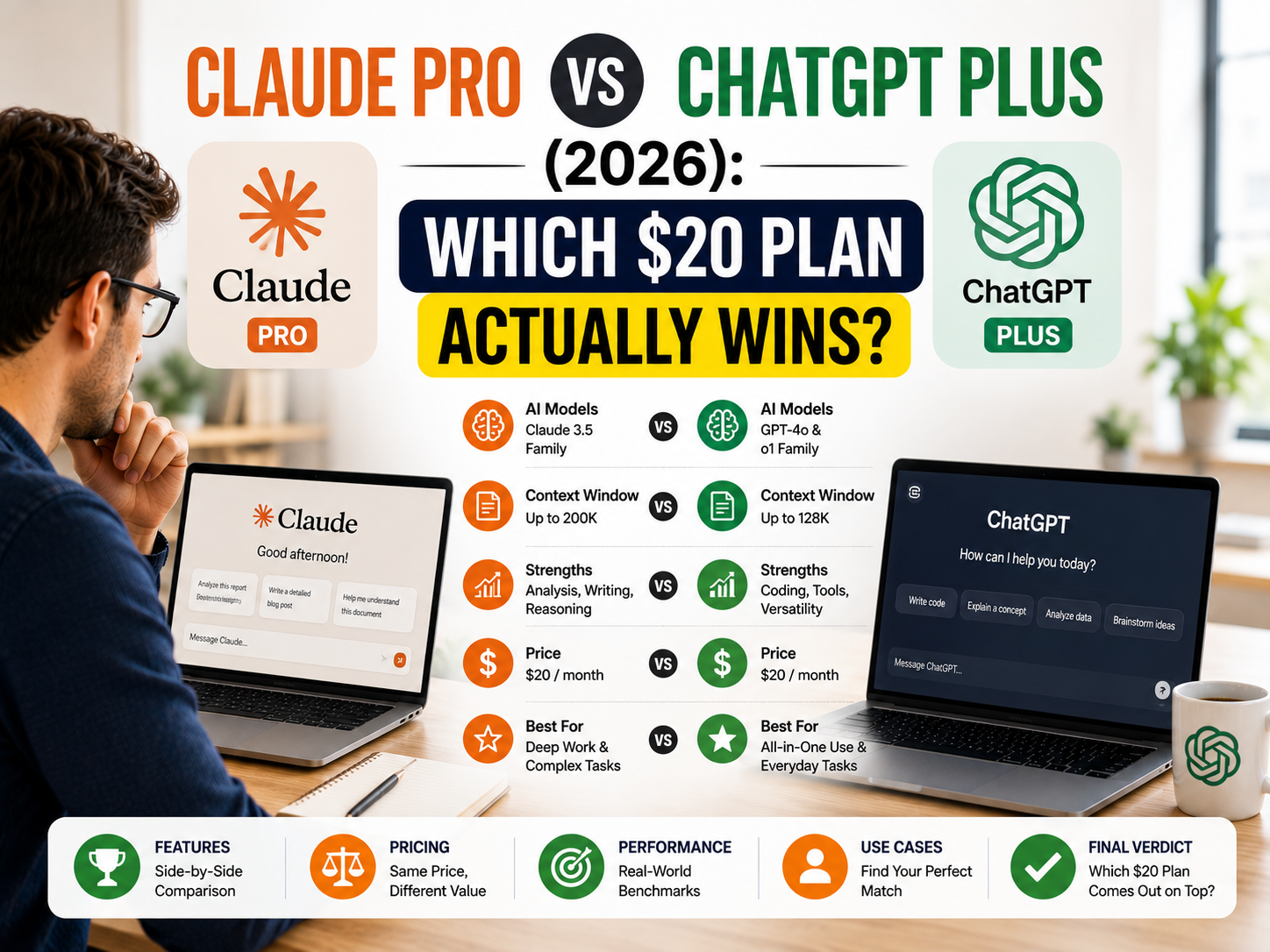
Claude Pro vs ChatGPT Plus (2026): Which $20 Plan Actually Wins?
Claude Pro and ChatGPT Plus both start at the same $20 a month, which makes them look interchangeable on paper. They aren’t. One bundles a coding agent, an agentic workspace, and a research tool into a flat-rate subscription; the other bundles a different coding agent, a different multi-step agent, and its own reasoning-mode context boost. Picking between them isn’t really about price — it’s about which set of tools you’ll actually reach for on a Tuesday afternoon.
Every number in this comparison comes straight from Anthropic’s pricing page and OpenAI’s pricing page, checked in September 2026 — so you can verify any of it yourself before you subscribe to either one.
What Is Claude Pro?
Claude Pro is Anthropic’s mid-tier subscription, sitting between the free plan and the usage-heavy Max tiers. Per Anthropic’s own pricing page, it costs $17 a month if you pay annually ($200 billed upfront), or $20 a month billed monthly.
For that price, Pro gives you more usage than the free plan across Claude’s current model lineup — Opus 5 and Sonnet 5 for everyday work, Haiku 4.5 for fast tasks, and usage-credit access to Fable 5.1, Anthropic’s most capable generally available model. It also folds in tools that used to live as separate products: Claude Code for programming, Claude Cowork (an agent that handles multi-step tasks across your files and connected apps), Claude Design, Claude Science, unlimited Projects to organize chats and documents, access to Research, and Claude for Microsoft 365. If you’re new to the product entirely, our walkthrough of how Claude AI works is a good place to start before deciding whether Pro is worth the upgrade.
One detail worth flagging: chat, Claude Code, and Cowork all draw from the same usage pool. A heavy coding afternoon and a heavy chat afternoon compete for the same quota, not separate ones.
What Is ChatGPT Plus?
ChatGPT Plus sits above OpenAI’s Free and Go tiers and below the two Pro tiers ($100 and $200 a month). Per OpenAI’s live pricing page, Plus costs a flat $20 a month — there’s currently no annual discount on Plus specifically; annual billing is only offered on the Business and Enterprise plans.
What you get: full access to GPT-5.6 Sol, OpenAI’s flagship reasoning model (Free and Go are limited to the lighter Luna and Terra variants), expanded Codex usage for coding, expanded access to ChatGPT Work — OpenAI’s multi-step agent, spanning files, connected apps, browser actions, and scheduled work — on desktop, web, and mobile, expanded deep research, more accurate image generation, and the ability to create and share your own custom GPTs. Plus also unlocks ChatGPT Sites, a feature for building and hosting small web apps directly from a chat, plus early access to new features before they reach Free or Go. If you’re weighing ChatGPT against other assistants entirely, our ChatGPT vs Grok comparison covers that separately.
Claude Pro vs ChatGPT Plus: Side-by-Side
| Category | Claude Pro | ChatGPT Plus |
|---|---|---|
| Monthly price | $20/mo, or $17/mo billed annually | $20/mo flat |
| Annual billing | Yes — $200 billed upfront | Not offered on Plus |
| Flagship model | Opus 5 & Sonnet 5 (Fable 5.1 via usage credits) | GPT-5.6 Sol |
| Context window (chat) | Sonnet 5: 1M tokens · Opus 5: 500K · Haiku 4.5: 200K | 54K (Instant) / 256K (Reasoning) |
| Coding agent included | Claude Code (shares the plan’s usage pool) | Codex, expanded usage |
| Agent workspace | Claude Cowork | ChatGPT Work (desktop, web, mobile) |
| Deep research | Access to Research | Expanded deep research |
| Build/host mini web apps | No direct equivalent | ChatGPT Sites |
| Projects & custom tools | Unlimited Projects | Projects, scheduled tasks, custom GPTs |
| Also included | Claude Design, Claude Science, Claude for Microsoft 365 | Advanced image generation, Excel/PPT/Sheets extensions |
| Team seat (annual, standard) | $20/seat/mo | $20/seat/mo (ChatGPT Business) |
Pricing and Value: Is $20 Really $20?
On paper, both plans list at $20 a month — but that’s only true if you pay monthly. Commit to a year and the picture changes. Claude Pro drops to an effective $200 billed upfront for the year, while ChatGPT Plus has no annual billing option at all: you pay $20 every month, twelve months a year, with no discount for committing. Over a full year, that works out to $200 for Claude Pro against $240 for ChatGPT Plus. If price is your deciding factor and you’re confident you’ll stick with the tool, that $40 gap is the single most concrete number in this whole comparison.
Coding: Claude Code vs Codex, Both Included at $20
Both companies now bundle their coding agent into the mid-tier plan instead of charging for it separately. Claude Pro includes Claude Code with full access, though it shares your overall Claude usage pool — the more you use chat, the less headroom Claude Code has in a given window. ChatGPT Plus includes “expanded” Codex usage, sitting between Go’s limited access and Pro’s maximum tier, though OpenAI doesn’t publish an exact task count for either. If coding is your primary use case rather than a side benefit, our deeper breakdown of Claude Code against the alternatives is worth reading before you decide — a plan’s usage cap matters a lot more once you’re running an agent daily instead of sending occasional chat messages.
Context Window: Where the Two Plans Actually Diverge
This is the clearest structural difference between the two plans — and it’s a bigger gap than it might look at a glance. Claude Pro’s window depends on which model you’re using in chat: Sonnet 5, the model most Pro users run by default, carries a 1 million token context window, per Anthropic’s own pricing documentation. Opus 5 runs at 500K in the chat interface (it can reach 1M inside Claude Code with usage credits enabled), and Haiku 4.5 is capped at 200K. The often-repeated “Claude is stuck at 200K” claim describes an older standard from earlier in Claude’s model history — it’s no longer accurate for Sonnet 5.
ChatGPT Plus, by comparison, carries a 54K total context window in Instant mode (roughly 40,000 words) and expands to 256K in Reasoning mode (roughly 192,000 words), according to OpenAI’s own plan-comparison table — figures unchanged since the GPT-5.6 rollout. That means for a single long task, Claude Pro’s default model can hold roughly four times more than ChatGPT Plus’s largest available window, without you needing to switch modes first. ChatGPT Plus’s number is also “total,” shared between input and output, the same way Claude’s is.
What Else Comes Bundled In
Beyond the headline model and coding tool, each plan quietly includes a handful of extras that shorter comparisons tend to skip.
Claude Pro also adds: Claude Design (a design-focused workspace), Claude Science (built for research-heavy work), Claude for Microsoft 365 integration, and full access to Anthropic’s Research tool for longer, multi-step lookups.
ChatGPT Plus also adds: Projects and scheduled tasks, the ability to create and share custom GPTs, expanded memory that carries context between chats, more complex image generation (including generation that routes through the Thinking model), Excel/PowerPoint/Google Sheets extensions, and a developer mode currently in beta.
Both plans deliberately hold back the admin-level features — SSO, SCIM, audit logs, role-based access — for their Team and Business/Enterprise tiers instead.
Which One Should You Choose?
Pick Claude Pro if:
- You already lean on Claude Code, or want an agent (Cowork) that works across files and connected apps with less setup
- You’d rather pay annually and save on the sticker price
- You regularly work with long documents or large codebases — Sonnet 5’s 1M-token window in chat is roughly 4x ChatGPT Plus’s largest available window
Pick ChatGPT Plus if:
- You rely on custom GPTs or want to build small tools with ChatGPT Sites
- Image generation is a regular part of your workflow
- You’re already embedded in the OpenAI ecosystem and don’t need the largest possible context window
Neither plan is a wrong choice at $20 a month. Plenty of people just run both — at $40 combined it’s not a huge outlay, and the two rarely compete for the same job anyway: Claude Pro tends to handle coding and longer writing, while ChatGPT Plus handles research, images, and quick multimodal tasks. If you’re still deciding, a single month of each on monthly billing is a cheap way to find out which one you actually reach for before locking into Claude’s annual discount. And if you’re weighing search-first alternatives instead of either of these, our Perplexity vs ChatGPT comparison and DeepSeek vs ChatGPT comparison cover two very different angles on the same price bracket.
Frequently Asked Questions
Is Claude Pro cheaper than ChatGPT Plus?
Yes, if you pay annually. Claude Pro costs $200 billed upfront for the year (Anthropic lists this as an effective $17/month), versus $20/month if billed monthly. ChatGPT Plus has no annual option and costs a flat $20/month regardless of billing frequency, which works out to $240/year.
What’s the actual difference between Claude Pro and ChatGPT Plus?
Claude Pro bundles Claude Code and Claude Cowork, and its default chat model (Sonnet 5) carries a 1M-token context window. ChatGPT Plus bundles Codex and ChatGPT Work with a smaller context window that varies by mode — 54K in Instant, 256K in Reasoning. Both cost around $20/month but structure their usage pools and included tools differently.
Is Claude Pro or ChatGPT Plus better for coding?
Both include their respective coding agent at no extra cost — Claude Code on Pro, Codex on Plus. Claude Code shares Claude’s overall usage pool, while ChatGPT Plus gets “expanded” (not maximum) Codex usage. Neither company publishes exact task limits, so the better fit often comes down to which agent and ecosystem you’re already used to.
How do Claude Pro and ChatGPT Plus usage limits compare?
Neither company publishes a fixed message count. Both use rolling usage windows that scale with conversation length, model choice, and features used, and both let you check current usage in account settings. Claude Pro’s limits reset on a 5-hour window with weekly caps layered on top; ChatGPT doesn’t publish an equivalent public breakdown for Plus.
Does Claude Pro really have a bigger context window than ChatGPT Plus?
Yes, for the default models most users run. Sonnet 5, Claude Pro’s default chat model, has a 1 million token context window as of September 2026. ChatGPT Plus tops out at 256K in Reasoning mode and 54K in Instant mode. The commonly repeated claim that Claude is capped at 200K describes an older generation of Claude models, not Sonnet 5.
Can I use Claude Pro and ChatGPT Plus at the same time?
Yes — there’s no restriction on subscribing to both. Many professionals run both plans and split tasks between them, since $40/month combined is a modest cost for two tools that don’t fully overlap in strengths.
Is Claude better than ChatGPT overall?
There’s no single answer — it depends on the task. Claude’s paid tier leans toward coding, long-document work, and longer-form writing with a significantly larger default context window; ChatGPT’s paid tier leans toward flexibility, image generation, and custom GPTs. Both are close enough in price that trying each for a month is often more useful than any single ranking.
For more head-to-head breakdowns like this one, browse every AI tool comparison we’ve published.
Pricing and features verified directly against Anthropic’s and OpenAI’s official pricing pages as of September 2026. Both companies change plans and limits regularly — confirm current details before subscribing.